
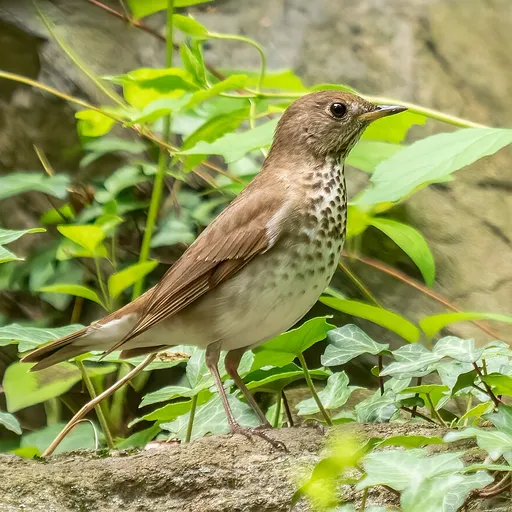
Grey-cheeked Thrush
Catharus minimus
Least Concern
Overview
The Grey-cheeked Thrush (Catharus minimus) is a medium-sized thrush that is all but indistinguishable from Bicknell's Thrush except for its slightly larger size and distinct song. It is the most northerly breeding of the American spotted thrushes and forms a cryptic species pair with Bicknell's Thrush.
Identification
- 15–17 cm in length with a wingspan of 32–34 cm, weighing between 26 and 30 g.
- Greyish face with a partial pale eyering, a drab grey-brown upperside, and extensively dusky flanks.
- White-dark-white underwing pattern characteristic of Catharus thrushes.
- Song consists of burry, flute-like notes that inflect downward, resembling a descending spiral but higher, thinner, and nasal than that of a Veery.
Habitat
A long-distance migrant, the Grey-cheeked Thrush breeds in northern boreal forests from Newfoundland to Alaska and across the Bering Sea to Eastern Siberia, associated with dense conifer and broadleaf shrub thickets. It prefers low coniferous woods, including young regenerating forests and dense, stunted spruce and fir on windblown sites near the tree line. The species is believed to spend its winter in the Amazon basin, crossing the Caribbean Sea and Gulf of Mexico during spring migration.
Diet
The bird consumes mainly insects such as beetles, weevils, ants, wasps, and caterpillars, alongside arachnids, crayfish, sow bugs, and earthworms. It also feeds on fruits and berries, including wild cherries, blackberries, and raspberries. Its habit of eating berries contributes to the dispersion of seeds.
Did you know?
It is more likely to hear the Grey-cheeked Thrush's nocturnal flight call during spring and fall migration than to observe the species on the ground. This nocturnal note is a one- or two-note 'whe-eer' that drops in pitch.
Sources
- Wikipedia · CC BY-SA 4.0
- Wikidata · CC0 1.0