
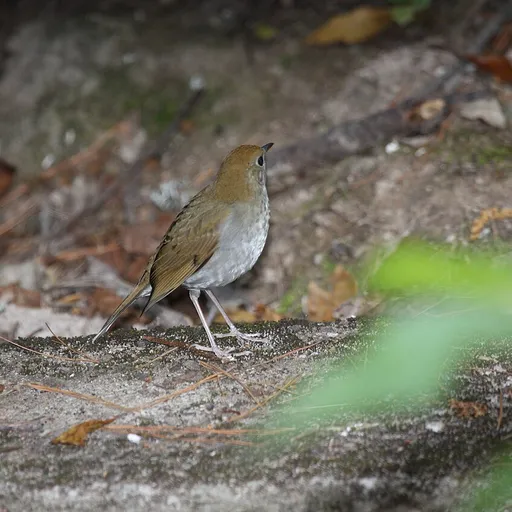
Russet Nightingale-Thrush
Catharus occidentalis
Least Concern
Overview
The russet nightingale-thrush (Catharus occidentalis) is a species of bird in the family Turdidae that is endemic to Mexico. It is assessed as Least Concern by the IUCN, with a large range and a population that is considered fairly common to common.
Identification
- Adults of the nominate subspecies possess a deep russet brown crown and nape, with a light olive brown or buffy olive face.
- Upperparts are mostly an olivaceous russet brown, while the uppertail coverts and tail are more rufescent than the back.
- Underparts include a buffy whitish to pale buff throat, often with faint streaks, and a pale buffy olive breast with indistinct darker spots.
- The song consists of varied, thin phrases with a tinny quality, described as 'she-vee-ee-i-lu' or 'chee ti-vee', often repeated in rapid succession.
Habitat
This species inhabits montane evergreen, pine-oak, and oak forest within the subtropical and lower temperate zones. Its distribution across Mexico is disjunct, with different subspecies found in northwestern, central, southwestern, and southern regions at elevations between 1,500 and 3,700 m.
Diet
The diet consists primarily of insects with some fruit. The bird usually forages singly, on the ground or near it, within the forest's understory.
Did you know?
The species was originally described in 1859, and its ruddy-capped relative was treated as a subspecies of the russet nightingale-thrush for much of the twentieth century before being split.
Sources
- Wikipedia · CC BY-SA 4.0
- Wikidata · CC0 1.0