
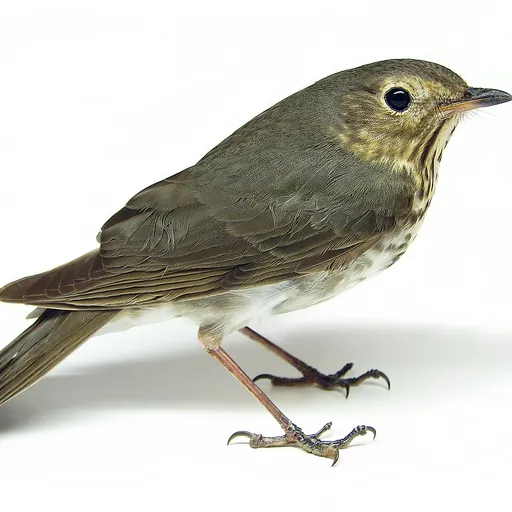
Swainson's Thrush
Catharus ustulatus
Least Concern
Listen
XC651538 · Rudyard W · San Francisco Peninsula (near San Francisco), San Francisco County, California, United States · CC0 1.0
Overview
The Swainson's thrush, also known as the olive-backed or russet-backed thrush, is a medium-sized bird belonging to the genus Catharus. It is characterised by subdued colouration and a distinctive, ascending flute-like voice. Named after the English ornithologist William Swainson, this species is classified as Least Concern on the IUCN Red List.
Identification
- Adults measure 16–20 cm in length with an average wingspan of 30 cm, featuring brown upperparts that are more olive-brown in eastern populations and reddish brown in western birds.
- Underparts are white with brown flanks, a lighter brown breast with darker spots, and a characteristic white-dark-white underwing pattern.
- Physical features include pink legs, a light brown eye ring, and a bill measuring 1.5–1.9 cm in length.
- The song consists of a hurried series of flute-like tones that spiral upwards.
Habitat
Breeding habitats include coniferous woods with dense undergrowth across Canada, Alaska, and the northern United States, as well as deciduous wooded areas on the Pacific coast of North America. The species migrates to southern Mexico and as far south as Argentina, with coastal subspecies wintering from Mexico to Costa Rica and continental birds travelling via Florida to winter in Panama and Bolivia. It is a very rare vagrant to western Europe and has been observed in northeast Asia.
Diet
Swainson's thrushes forage on the forest floor and in trees, primarily consuming insects, fruits, and berries. In high-elevation areas, such as the White Mountains of New Hampshire, their diet shifts to include more detritivores like woodlice and ghost spiders, which are abundant but nutrient-poor at those altitudes. They construct cup nests on horizontal tree branches.
Did you know?
Local tribes, including the Saanich, Tlingit, and Haida, believe that the bird's song causes salmonberries to ripen, with some claiming it says, "xwexwelexwelexwelexwesh!" meaning "ripen, ripen, ripen, ripen!". Molecular systematics indicate that Catharus ustulatus is the most ancient North American species of its genus, with its outward similarities to other Catharus species resulting from convergent evolution rather than close relation.
Sources
- Wikipedia · CC BY-SA 4.0
- Wikidata · CC0 1.0