
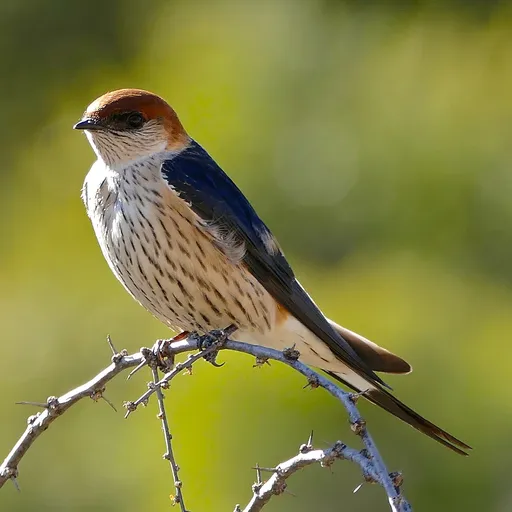
Greater Striped Swallow
Cecropis cucullata
Least Concern
Overview
The greater striped swallow (Cecropis cucullata) is a large swallow native to Africa south of the equator. It is currently classified as Least Concern on the IUCN Red List.
Identification
- 18–20 cm long with dark blue upperparts, a pale orange rump, and a chestnut crown and nape.
- Creamy white underparts and underwing coverts marked with dark streaking, and blackish-brown upper wings and flight feathers.
- Blackish tail with very long outer feathers that are slightly longer in males than in females.
- Slow and buoyant flight accompanied by a twittering 'chissick' call.
Habitat
Breeding primarily in southern Africa, specifically South Africa, Namibia, and southern Zimbabwe, this species migrates north to winter in Angola, Tanzania, and the southern Democratic Republic of the Congo. It inhabits dry open country such as grassland, with a preference for hills and mountains, and avoids wooded areas. Although it selects high natural sites like caves or rock overhangs, it frequently nests in human-made structures such as bridges and buildings.
Diet
Feeds mainly on flying insects, though it has also been observed eating small fruits.
Did you know?
The genus name Cecropis is derived from the Ancient Greek word for 'Athenian woman', while the specific epithet cucullata comes from a Latin term meaning 'hooded'.
Sources
- Wikipedia · CC BY-SA 4.0
- Wikidata · CC0 1.0