
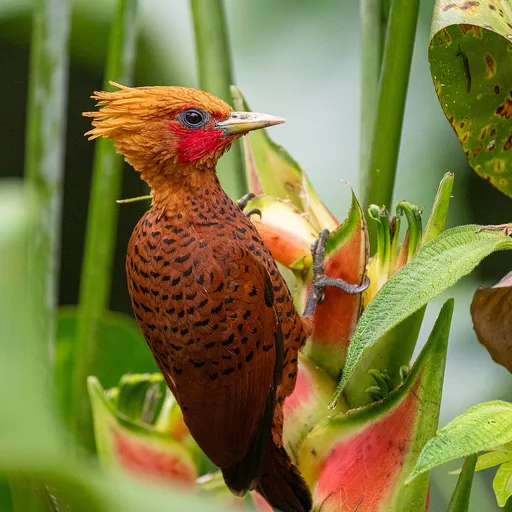
Chestnut-colored Woodpecker
Celeus castaneus
Least Concern
Overview
The chestnut-colored woodpecker is a species of bird in the woodpecker family Picidae. It is found on the Caribbean side of Middle America, ranging from southern Mexico to Panama. The species is classified as Least Concern by the IUCN.
Identification
- Celeus castaneus measures 21.5 to 25 cm in length and has dull ochraceous or tawny heads with a pointed crest.
- Males display bright red coloration from the lores to behind the eye and down to the throat, while females lack this red marking.
- The upperparts are rufous-chestnut with black bars on the back and cinnamon-buff rump, and the underparts are chestnut heavily marked with black "V" or "U" shapes.
- The common vocalization is described as a falling "skeew" succeeded by a nasal "keh, keh, keh," along with a "sharp 2-part wi-kah" and a nasal "peahh".
Habitat
The bird primarily inhabits the interior and edges of humid evergreen and semi-deciduous forests, favoring dense foliage even at the forest edge. It is also found in mangroves and coastal scrub in some areas. Its elevation range extends from sea level to 1,000 m in Mexico and up to 750 m in Costa Rica.
Diet
The chestnut-colored woodpecker mostly feeds on ants and termites, but also consumes smaller amounts of other insects and fruit. It typically forages alone or in pairs within the canopy and subcanopy, seeking prey by pecking into tunnels and prying off bark.
Did you know?
Both sexes participate in the breeding process by excavating the nest cavity, which is usually located in a tree.
Sources
- Wikipedia · CC BY-SA 4.0
- Wikidata · CC0 1.0