
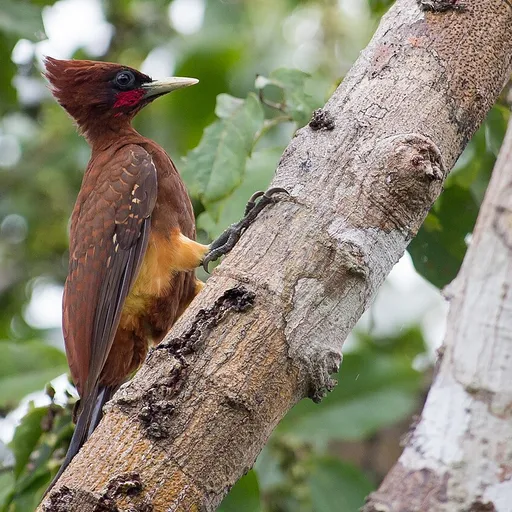
Chestnut Woodpecker
Celeus elegans
Least Concern
Overview
The chestnut woodpecker (Celeus elegans) is a species of bird in the family Picidae, found across much of mainland South America and on Trinidad. It is assessed as a species of Least Concern by the IUCN, although its population is believed to be decreasing.
Identification
- Adults measure between 26 and 32 cm in length, with a bill that is ivory, yellow, or greenish-yellow.
- Males possess a wide bright red malar area and cheek, whereas females lack this red coloration.
- The nominate subspecies features a buffish cream forehead, crown, and crest, contrasting with a deep chestnut brown head and underparts.
- Upperparts are deep rufous-chestnut with a cream-buff rump, and flight feathers are blackish-brown with rufous bars at the base.
- The territorial call is described as a descending 'wewa ew-ew-ew-ew-ew-ew' or a sarcastic-sounding 'har-hahaha'.
Habitat
The chestnut woodpecker inhabits the interior and edges of both dense and lighter forests, including terra firme, gallery, and várzea forests, as well as secondary forest, cocoa, and other plantations. Its elevation range varies by location, extending from sea level to as high as 1,100 m in Peru. It is a year-round resident throughout its range, which covers eastern Venezuela, Guyana, western Suriname, northern Roraima, eastern Suriname, French Guiana, northern Brazil, eastern Ecuador, eastern Peru, western and central Brazil, northern Bolivia, and Trinidad.
Diet
The primary food of the chestnut woodpecker consists of ants and termites, with fly larvae and fruit also being significant parts of its diet. It forages singly, in pairs, or in small loose groups, and frequently joins mixed-species feeding flocks. Prey is captured by gleaning from trees and by breaking open arboreal termitaria, usually from the understorey to the sub-canopy on trunks and large limbs.
Did you know?
Some taxonomic studies have found that the subspecies citreopygius and jumanus are more closely related to the blond-crested woodpecker (Celeus flavescens) than to the other chestnut woodpecker subspecies, leading to their occasional treatment as separate species.
Sources
- Wikipedia · CC BY-SA 4.0
- Wikidata · CC0 1.0