
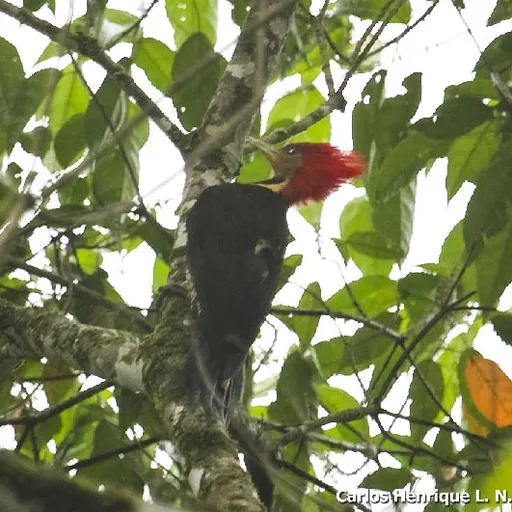
Helmeted Woodpecker
Celeus galeatus
Vulnerable
Overview
The helmeted woodpecker (Celeus galeatus) is a vulnerable bird species within the woodpecker family Picidae. Its specific epithet derives from the Latin word galea, meaning 'helmet', referring to its prominent crest. It is found in parts of Argentina, Brazil, and Paraguay.
Identification
- Approximately 25 cm in length with a 31.5–35 mm ivory bill featuring a grey or blue-grey base.
- Cinnamon face with a long red crest; adult males possess a red malar patch extending down the throat and around the back of the head, whereas females have no additional red on the head.
- Black throat and hindneck separated by a vertical white stripe, with black upperparts transitioning to buff lower back and cream-buff uppertail coverts.
- Emits a strident, drawn-out 'kwee-kwee-kwee-kwee' long call that can be heard from over 500 m away, alongside a mournful, descending 'tu-du-du' call.
Habitat
Primarily inhabits large tracts of Atlantic Forest, including semi-deciduous and mixed deciduous-coniferous types, at elevations from sea level to 1,000 m. It occasionally occurs in disturbed forests, plantations of introduced trees, and small forest fragments. Its range covers the southern Brazilian states of São Paulo, Paraná, and Santa Catarina, the eastern half of Paraguay, and Misiones Province in northeastern Argentina.
Diet
Forages mostly in the forest mid-storey by gently probing soft decaying trees, with less hammering or bark flaking. Its diet includes insect larvae, and less frequently ants and berries. It is usually seen foraging singly or in pairs, though it may join mixed-species feeding flocks.
Did you know?
The species exhibits apparent mimicry of two larger woodpeckers, the lineated woodpecker and the robust woodpecker, a resemblance that likely reduces aggression towards it but results from evolutionary convergence rather than phylogenetic affinity.
Sources
- Wikipedia · CC BY-SA 4.0
- Wikidata · CC0 1.0