
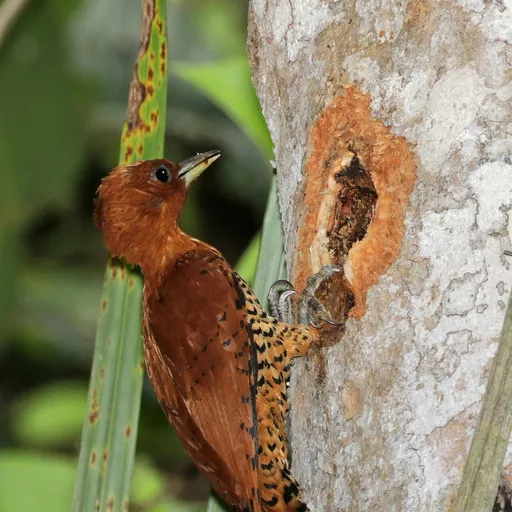
Cinnamon Woodpecker
Celeus loricatus
Least Concern
Listen
XC759710 · radrat · Corregimiento de Cristóbal (near Gamboa), Colón, Colón Province, Panama · CC0 1.0
Overview
The cinnamon woodpecker (Celeus loricatus) is a species of woodpecker in the family Picidae, characterised by its rufous plumage and bushy crest. It is currently assessed as Least Concern by the IUCN, with an estimated population of at least 50,000 mature individuals that is believed to be decreasing.
Identification
- Measures 19 to 23 cm in length and weighs 74 to 83 g, with a medium-long grayish to yellowish bill and red iris.
- Both sexes feature rufous heads with a bushy crest and black crown streaks; males display a red chin, throat, and malar, while females are rufous in these areas.
- Underparts consist of a light rufous upper breast with black edges, transitioning to paler buff lower parts marked with bold black arrowhead-shaped patterns.
- Vocalisations include a loud, far-carrying 'wheeét!-wheeét-wheet-it' call, often preceded by 'chuweeo', and slow, short drumming.
Habitat
Found in Colombia, Costa Rica, Ecuador, Nicaragua, and Panama, this species primarily inhabits the interior of humid to wet forests, occasionally extending to forest edges, treed pastures, and clearings. It ranges in elevation from sea level up to 1,500 m in Colombia, with lower maximum altitudes in Costa Rica, Panama, and Ecuador.
Diet
Ants and termites constitute the primary diet, supplemented by fruits such as bananas. The bird typically forages singly or in pairs within the canopy, though it hunts lower in open areas and may occasionally join mixed-species feeding flocks. Feeding methods involve pecking for prey as well as gleaning.
Did you know?
Despite its striking appearance, the cinnamon woodpecker is generally uncommon and more often heard than seen across its range. Both sexes actively participate in excavating nest cavities in living or recently dead trees, typically situated between 6 and 9 m above the ground.
Sources
- Wikipedia · CC BY-SA 4.0
- Wikidata · CC0 1.0