
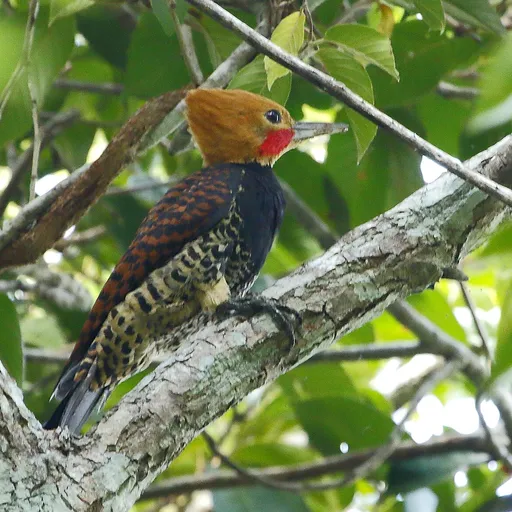
Ringed Woodpecker
Celeus torquatus
Least Concern
Overview
The ringed woodpecker (Celeus torquatus) is a species of bird in the subfamily Picinae of the woodpecker family Picidae. It is native to mainland South America, excluding Argentina, Chile, Paraguay, and Uruguay, and is currently assessed as Least Concern on the IUCN Red List.
Identification
- Measures 26 to 29 cm in length, with a moderately bushy crest and a pale cinnamon head with a rufous tinge.
- Males possess a red patch from the malar area to under the ear coverts, while females lack red on the head.
- Subspecies exhibit varied plumage, ranging from a black lower throat and breast with cinnamon-buff underparts in the nominate to tawny rufous underparts with black bars in C. t. occidentalis.
- Vocalisations include a primary call of 2–7 loud ringing whistles at a stable pitch and a rising call of 4–9 strident whistles that increase in pitch and amplitude.
Habitat
Found across most of mainland South America, with the nominate subspecies in northeastern Venezuela, the Guianas, and northern Amazonian Brazil, while C. t. occidentalis occupies the western and central Amazon, and C. t. tinnunculus resides in the Atlantic Forest of eastern Brazil. The species primarily inhabits tall humid tropical forests, including terra firme, várzea, secondary forest, gallery forest, and cerrado, while the Atlantic subspecies is restricted to closed canopy Atlantic Forest.
Diet
The diet includes ants, seeds, and fruit, though detailed composition is not fully known. Foraging strategies vary by region, typically occurring from the forest understorey to below the canopy, or from mid-level up in the western range. It forages singly, in pairs, or in small groups, obtaining prey by gleaning, chiseling small holes into wood, and hammering open arboreal termitaria.
Did you know?
Despite being a woodpecker, the species rarely drums, producing only short bursts of 1–2 seconds with knocks at a stable pace of 15–20 per second. Most of its vocal activity is concentrated at dawn, with very little calling occurring during the day.
Sources
- Wikipedia · CC BY-SA 4.0
- Wikidata · CC0 1.0