
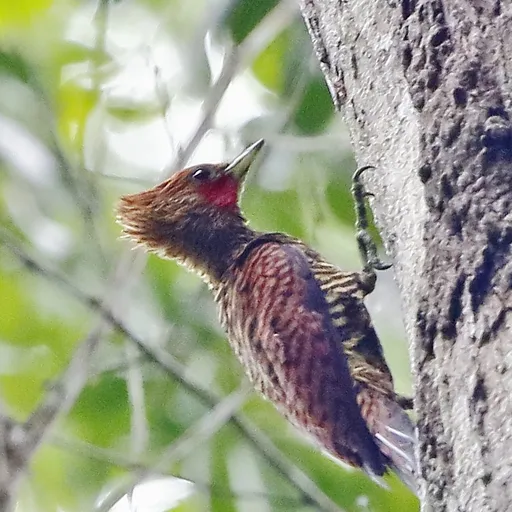
Waved Woodpecker
Celeus undatus
Least Concern
Overview
The waved woodpecker, also known as the variable woodpecker, is a species of bird in the family Picidae. It is classified as Least Concern by the IUCN, although its population is believed to be decreasing due to habitat loss.
Identification
- Length of 23 to 26 cm with rufous-chestnut upperparts featuring wide black bars; the specific epithet undatus refers to these wavy markings.
- Head is light chestnut-rufous with a bushy crest; males possess a wide red band from behind the bill to the ear coverts, which females lack.
- A shortish, dull yellow to yellow-green bill, red-brown to red irises, and green-gray legs.
- Vocalisations include a high, nasal 'fuweét-eeuh' and loud, metallic 'pring-pring!' notes.
Habitat
Found across northern and eastern South America, including Bolivia, Brazil, Colombia, Ecuador, French Guiana, Guyana, Peru, Suriname, and Venezuela. It inhabits varied wooded landscapes such as rainforest interiors and edges, terra firme and várzea forests, secondary forest, and treed savannahs. Typically occurs between 100 and 900 m elevation, though locally found as high as 1,140 m.
Diet
The primary food consists of ants and termites, supplemented by sap, seeds, fruits, and berries. It usually forages singly, in pairs, or in small family groups, though it may join mixed-species feeding flocks. Prey is captured by pecking, probing, and gleaning on tree trunks, branches, and vines from the mid-level to the canopy.
Did you know?
The bird's common name derives from the Medieval Latin specific epithet undatus, meaning 'wavy' or 'wavelike', which describes the irregular black bars on its rufous underparts.
Sources
- Wikipedia · CC BY-SA 4.0
- Wikidata · CC0 1.0