
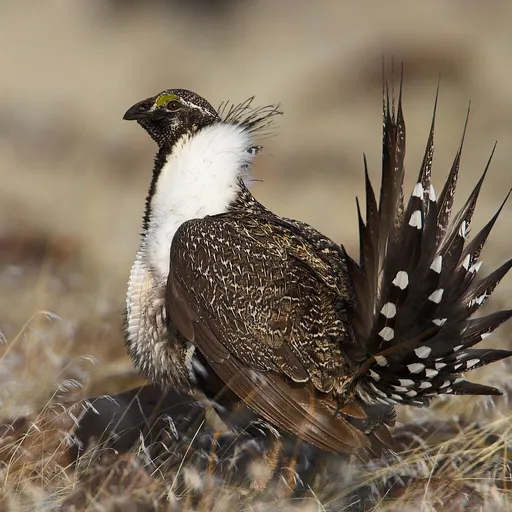
Sage Grouse
Centrocercus urophasianus
Vulnerable
Overview
The greater sage-grouse, also known as the sagehen, is the largest grouse in North America and an obligate resident of the sagebrush ecosystem. Currently classified as Vulnerable on the IUCN Red List, the species has suffered significant population declines due to habitat loss across the western United States and Canada.
Identification
- Males are larger, ranging from 66–76 cm in length, with a greyish top, white breast, dark brown throat, and black belly.
- Females are smaller, measuring 48–58 cm, and are mottled grey-brown with a light brown throat and dark belly.
- Adult males possess a long, pointed tail, legs feathered to the toes, and a distinctive yellow patch over each eye, along with two yellowish neck sacs used in courtship displays.
Habitat
The species inhabits sagebrush-grassland or juniper sagebrush-grassland communities across the western United States and southern Alberta and Saskatchewan, Canada. They prefer mountain and Wyoming big sagebrush over basin big sagebrush and are largely permanent residents, though they may move to lower elevations in winter to avoid deep snow.
Diet
Greater sage-grouse are highly selective ground foragers that lack a muscular gizzard, meaning they cannot digest hard seeds and must consume soft-tissue foods. Their diet is dominated by sagebrush, particularly mountain and Wyoming subspecies, complemented by herbaceous leaves such as dandelions, legumes, and yarrow. Juveniles require insects, especially beetles and ants, for survival and growth during their first few weeks of life.
Did you know?
The species lacks a muscular gizzard, which means it cannot grind and digest hard seeds like other grouse, forcing it to rely exclusively on soft-tissue plants and insects.
Sources
- Wikipedia · CC BY-SA 4.0
- Wikidata · CC0 1.0