
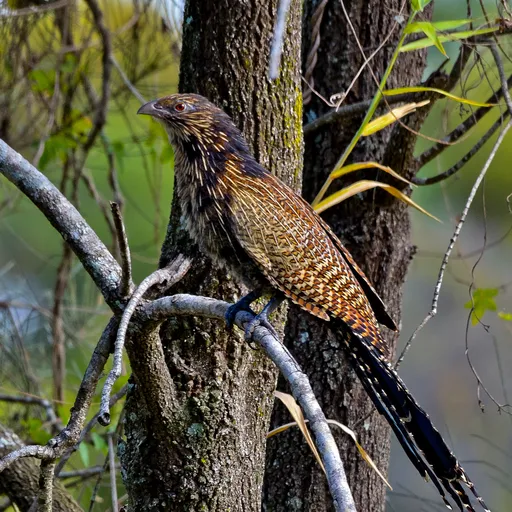
Pheasant Coucal
Centropus phasianinus
Least Concern
Overview
The pheasant coucal (Centropus phasianinus) is a large cuckoo found in Australia, Timor, and New Guinea. It is notable for being a brood-raiser rather than a brood parasite, meaning it incubates and raises its own young.
Identification
- 50 to 70 cm long, heavy-set bird resembling a pheasant in shape, adapted for terrestrial life.
- Breeding plumage features black heads, necks, breasts, and bellies with barred chestnut wings and long, barred tails.
- Non-breeding plumage sees the black head and underparts moult to a white-streaked chestnut colour.
- Summer vocalisation is a low descending 'boop boop boop', while winter calls are sharp hisses.
Habitat
Found in eastern and northern Australia from New South Wales to Cape York and the Pilbara, as well as eastern Timor and lowland New Guinea. It inhabits subtropical or tropical moist lowland forests and mangroves, often utilising dense understory in shrubs, tall grasses, swamps, and cane plantations.
Diet
Predominantly carnivorous, the pheasant coucal preys on small reptiles, amphibians, bird eggs and young, small mammals, and large insects. As an opportunistic predator, it has even been observed attacking birds caught in mist nets.
Did you know?
The male pheasant coucal performs the bulk of the parental duties, including building the nest, incubating the eggs, and feeding the young.
Sources
- Wikipedia · CC BY-SA 4.0
- Wikidata · CC0 1.0