
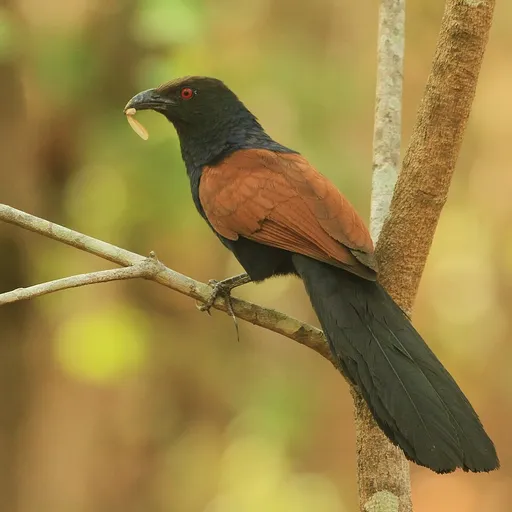
Greater Coucal
Centropus sinensis
Least Concern
Listen
XC676987 · Manoj Karingamadathil · Ezhome, Kannur, Kerala, India · CC BY-SA 4.0
Overview
The greater coucal, also known as the crow pheasant, is a large non-parasitic member of the cuckoo family found across the Indian subcontinent and Southeast Asia. This widespread resident is classified as Least Concern on the IUCN Red List.
Identification
- Large, crow-like bird measuring 48 cm with a long tail, black head, and chestnut brown back and wings.
- Centropus sinensis features ruby red eyes and an underside that is black and glossed with purple, whereas juveniles are duller with white bars on the underside and tail.
- Produces a familiar deep, resonant booming call described as 'coop-coop-coops', often accompanied by a rapid rattling 'lotok, lotok' or a harsh scolding 'skeeaaaw'.
Habitat
Found in a wide range of environments from jungle and cultivation to urban gardens across the Indian subcontinent and Southeast Asia. Its distribution extends from the Indus Valley through the sub-Himalayan and Gangetic plains into southern China, and southwards through the Malay Peninsula and islands including Sumatra, Java, Borneo, and the western Philippines.
Diet
Forages on the ground and in vegetation for insects, caterpillars, snails, and small vertebrates such as saw-scaled vipers. It also consumes bird eggs, nestlings, fruits, and seeds, including the toxic fruits of Cascabela thevetia and the mesocarps of oil palm, which has led to it being considered a pest in plantations.
Did you know?
In Bengal, local belief held that monocled cobras had no males and that they mated with male greater coucals. The bird's deep calls are widely associated with spirits and omens throughout its range.
Sources
- Wikipedia · CC BY-SA 4.0
- Wikidata · CC0 1.0