
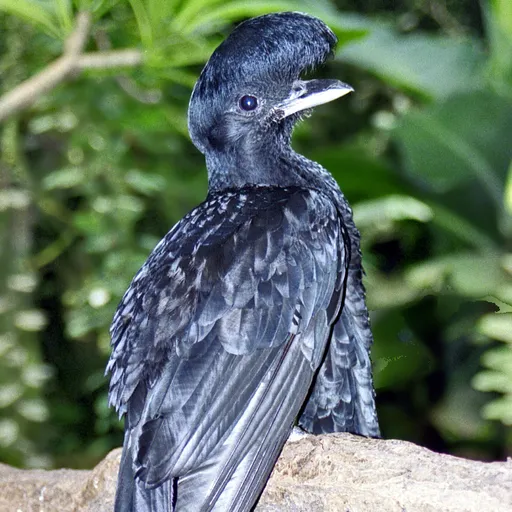
Long-wattled Umbrellabird
Cephalopterus penduliger
Vulnerable
Listen
XC250607 · Niels Krabbe · El Oro: Reserva Buenaventura 9 km WNW Piñas, Ecuador · CC BY-SA 4.0
Overview
The long-wattled umbrellabird (Cephalopterus penduliger) is a rare member of the cotinga family found in the humid forests of the Andes. It is a sexually dimorphic species, with males distinguished by a large, erectile head crest and a prominent throat wattle. Classified as Vulnerable by the IUCN, the species faces threats from habitat destruction and hunting.
Identification
- Males measure 40–42 cm in length, while females are slightly smaller at 35–37 cm.
- Both sexes are short-tailed with erectile head crests, though male crests are longer (20–30 cm).
- Males possess a large, retractable throat wattle, whereas females and juveniles have none or only a small one.
- Males generally feature black shafts in their feathers.
Habitat
This species inhabits humid to wet premontane and cloud forests on the ridges and sides of the Andes range at altitudes of 1,500–1,800 m above sea level. It is found from the southwestern part of Colombia to the province of El Oro in Ecuador, within the Tumbes–Chocó–Magdalena bioregion.
Diet
The long-wattled umbrellabird is mostly frugivorous, preferring the fruits of the Arecaceae, Lauraceae, and Myrtaceae families. It also consumes invertebrates and small vertebrates. Females provide food to their nestlings by delivering invertebrates, vertebrates, and regurgitated material approximately once per hour.
Did you know?
The species' scientific name, penduliger, is derived from the Latin word for 'hanging', referring to its distinctive wattle. During lek mating, males compete by displaying aggression and territorial behaviour, traits that solitary females use to select a mate.
Sources
- Wikipedia · CC BY-SA 4.0
- Wikidata · CC0 1.0