
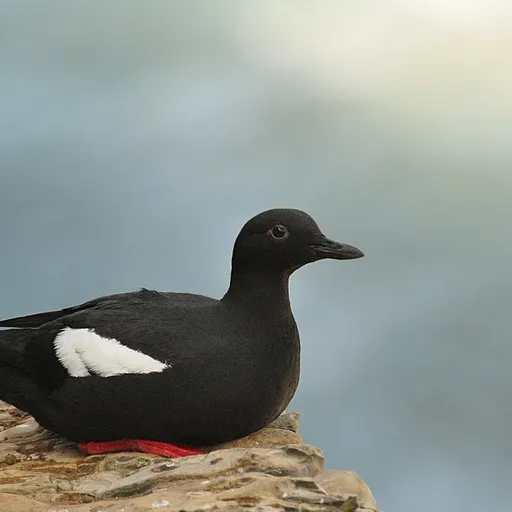
Pigeon Guillemot
Cepphus columba
Least Concern
Listen
XC926084 · steve · Petersburg, Petersburg Borough, Alaska, United States · CC BY-SA 4.0
Overview
The pigeon guillemot (Cepphus columba) is a medium-sized seabird in the auk family, ranging across the North Pacific from Siberia to California. It is classified as a Least Concern species by the IUCN Red List due to its large, stable population and wide distribution.
Identification
- Breeding adults display dark brown plumage with a black iridescent sheen and a distinctive white wing patch broken by a brown-black wedge.
- Non-breeding plumage features mottled grey and black upperparts with white underparts, and iridescent black upperparts with scalloped edges in winter.
- Medium-sized, measuring 30 to 37 cm in length, with a long black bill, black claws, and red legs and feet.
- Highly vocal with calls such as the hunch-whistle used for territory advertisement and trills used for pair bonding and territorial display.
Habitat
This species inhabits rocky shores, cliffs, and islands close to shallow water, typically less than 50 m deep, for breeding. In winter, it forages along rocky coasts, often in sheltered coves, and may be found on the continental shelf break or in ice openings in northern regions.
Diet
The pigeon guillemot feeds on small fish and marine invertebrates, such as sculpins, sandfish, cod, capelin, shrimp, and crabs, primarily foraging near the sea floor. It forages by pursuit diving, often hanging upside down above the seafloor to probe for prey while using its feet and wings for propulsion.
Did you know?
Unusually for auks, pigeon guillemots use their feet for propulsion when diving, allowing them to hang upside down above the seafloor to probe for food.
Sources
- Wikipedia · CC BY-SA 4.0
- Wikidata · CC0 1.0