
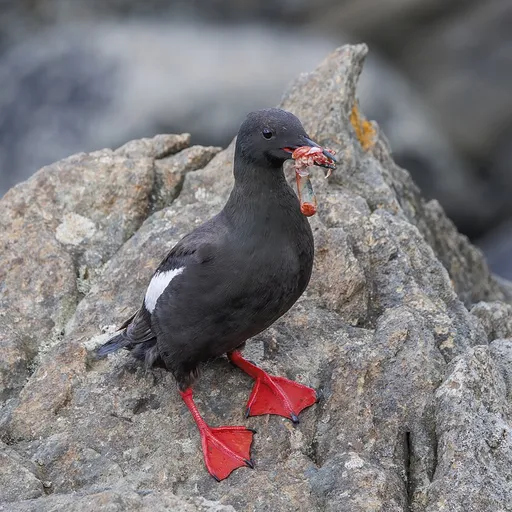
Black Guillemot
Cepphus grylle
Least Concern
Overview
The black guillemot (Cepphus grylle), also known as the tystie, is a medium-sized seabird in the family Alcidae native to northern Atlantic coasts. It is resident in temperate zones but populations from the high Arctic migrate southwards in winter.
Identification
- In summer, adults are entirely black with a large white patch on the upper wing and coral-red legs and feet.
- In winter, upperparts become pale grey with barred light grey and white patterns, while underparts turn white and the legs fade to pale red.
- Adults measure 30–32 cm in length with a wingspan of 52–58 cm and a long, slender black bill.
- Breeding call is a high whistle, and the red gape is prominent during this season.
Habitat
This circumpolar species breeds between 43° and 82°N latitude across boreal, low Arctic, and high Arctic regions of the North Atlantic and Arctic Oceans. It typically inhabits rocky shores, utilizing cliffs, crevices, and boulders for nesting. In Britain, it is a fairly common breeder in Ireland and the west and north of Scotland, with limited presence elsewhere on the mainland.
Diet
Black guillemots forage mainly in inshore waters less than 50 m deep, diving 15–20 m to catch benthic prey such as fish, crustaceans, molluscs, and jellyfish. They use their wings to propel themselves forward and feet to steer, swallowing small prey whole while bringing larger items to the surface to soften them before ingestion.
Did you know?
Despite being coastal foragers, black guillemots were among the few bird species to breed on Surtsey, a new volcanic island in Iceland. They are also known as single-prey loaders, which restricts their foraging range because chicks require a high volume of individual energy-rich items throughout the day.
Sources
- Wikipedia · CC BY-SA 4.0
- Wikidata · CC0 1.0