
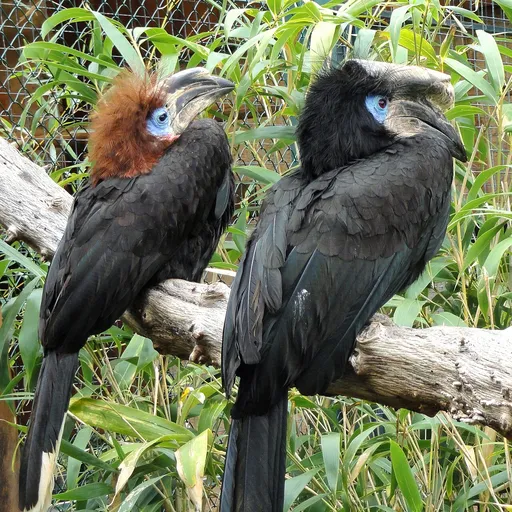
Black-casqued Hornbill
Ceratogymna atrata
Near Threatened
Overview
The black-casqued hornbill (Ceratogymna atrata) is a large, mostly black bird in the family Bucerotidae, currently classified as Near Threatened with a declining population. It is distributed fairly commonly across sub-Saharan Africa, ranging from Sierra Leone and Liberia in the west to Angola in the south and the Democratic Republic of the Congo and western Uganda in the east.
Identification
- Large bird, typically 60–70 cm long, with predominantly black plumage featuring distinctive white scales that distinguish it from the similar yellow-casqued hornbill.
- Possesses a prominent casque on the beak and bare blue wattles and skin around the eyes.
- Sexual dimorphism is visible as males have black heads and larger casques, whereas females have brown hoods of feathers.
- Vocalisations include a powerful 'braying' call audible over 2 km, along with resonant squawks and soft chuckling alarm calls.
Habitat
These birds primarily inhabit lowland evergreen forests, spending most of their time high in the trees, though they also occur in nearby plantations and mature secondary growth. Their range extends across sub-Saharan Africa, from West Africa along the Gulf of Guinea south to Angola and east to western Uganda.
Diet
Largely frugivorous, with fruit constituting 90% of their diet, particularly figs and oil palm fruits from at least 20 plant families. They also consume a small amount of meat by hawking for insects above the canopy and raiding the nests of other birds, such as weavers.
Did you know?
During breeding, the female is sealed inside the nest cavity by the pair, leaving only a small opening through which the male delivers food. Breeding frequency is directly determined by fruit availability, with some populations ceasing nest construction entirely during hard years.
Sources
- Wikipedia · CC BY-SA 4.0
- Wikidata · CC0 1.0