
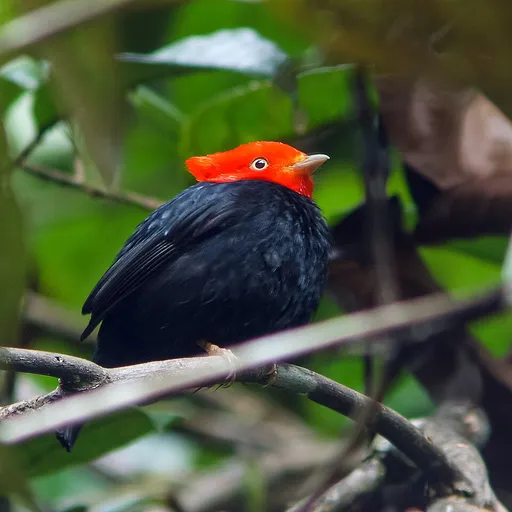
Scarlet-horned Manakin
Ceratopipra cornuta
Least Concern
Overview
The scarlet-horned manakin (Ceratopipra cornuta) is a species of bird in the family Pipridae, classified as Ceratopipra cornuta in the early 2000s after previously being described as Pipra cornuta. It is a year-round resident found in Brazil, Guyana, and Venezuela, where it is considered fairly common to common in Venezuela and rare in Brazil. The IUCN has assessed its conservation status as Least Concern, with a population believed to be stable and no immediate threats identified.
Identification
- Males are approximately 12.5 cm long and average 23.5 g, featuring an entirely red head and neck with elongated hindcrown feathers curving upward to form two eponymous horns, black plumage on the rest of the body, and red thighs.
- Females are mostly dull olive-green with lighter underparts and elongated hindcrown feathers that are less pronounced than those of males.
- Both sexes have pink to brownish legs and feet; males possess a white iris and pale pink bill, whereas females have a darker iris and browner bill.
- Vocalisations include an abrupt crackling or rough-sounding "P'R'ROP!" produced by the wings, likened to an electric bug zapper, along with squeaky, metallic calls described as "squee-ke-Slick!" and "ee'Slick! and Skip!".
Habitat
The scarlet-horned manakin inhabits tepuis in the region where eastern Venezuela, western Guyana's Cuyuni-Mazaruni, and extreme northern Brazil's Roraima meet, specifically in Venezuela's Amazonas and Bolívar states. It resides in humid forest and mature secondary woodland at elevations between 500 and 1,800 m, where much suitable habitat remains and forest is often effectively inaccessible to major human intrusions.
Diet
The species feeds on small fruits, including those from the Melastomataceae family. It forages by plucking fruit with short flights from a perch, sometimes incorporating a brief hover during the process.
Did you know?
Males perform a complex courtship display in a lek that includes sliding backward on a perch, tail-flicking, rapid flights, and turning around upon landing to prominently display their red thighs. The breeding season centres around January to March, with the one known nest being a small open cup in a branch fork holding two nestlings fed by the female.
Sources
- Wikipedia · CC BY-SA 4.0
- Wikidata · CC0 1.0