
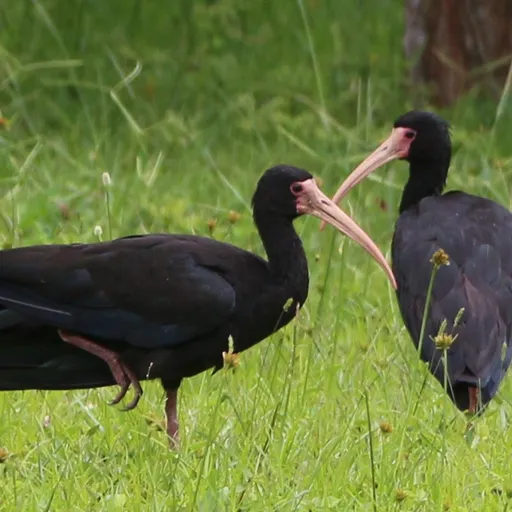
Sharp-tailed Ibis
Cercibis oxycerca
Least Concern
Overview
The sharp-tailed ibis (Cercibis oxycerca) is a large species of ibis native to the open wet savannas of northern South America. It is monotypic within its genus and is distinguished from other ibises by its notably long tail and large body size. The species is currently classified as Least Concern on the IUCN Red List.
Identification
- Predominantly black plumage with greenish glossing and purplish tinges on the upper back, hindneck, wings, and tail.
- Possesses the longest tail of any extant ibis, projecting beyond the folded wings when standing and beyond the legs in flight.
- Features orangey-red bill, legs, toes, and bare facial skin, with a yellowish-orange throat and a feathered grey strip below the eye.
- Produces a loud, distinct call resembling a saxophone or toy trumpet, described as 'cuk', 'turuck', or the nasal 'TUUR-DEE'.
Habitat
Found in wet lowland savannas, riverbanks, and marshy edges of lagoons in northern South America east of the Andes, typically below 300–500 m above sea level. Its range includes Venezuela, eastern Colombia, southwestern Guyana, Brazil, and Suriname, often associated with major rivers such as the Orinoco, Apure, and Rio Negro. The species may also utilise gallery forests for roosting and breeding.
Diet
Primarily feeds on medium-sized insects, especially during the dry season, and occasionally on amphibians, crustaceans, earthworms, and snails. Foraging is largely terrestrial or semi-terrestrial, involving quick walking over moist soil or shallow mud to probe deeply for prey. It is less aquatic in its feeding habits than many other South American ibises.
Did you know?
Unlike most llanos wading birds which breed in the wet season, the sharp-tailed ibis breeds solitarily in gallery forests from August to February. It is so secretive during this period that it is often absent from open grasslands, making it difficult to detect despite its relatively large global population.
Sources
- Wikipedia · CC BY-SA 4.0
- Wikidata · CC0 1.0