
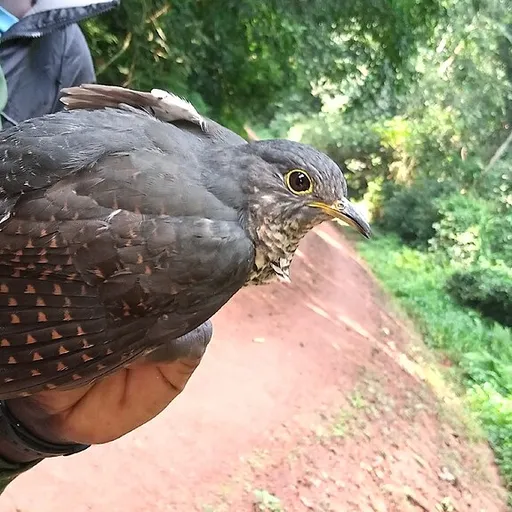
Dusky Long-tailed Cuckoo
Cercococcyx mechowi
Least Concern
Listen
XC621050 · paulo kivuyo · Minziro, Missenyi, Kagera Region, Tanzania · CC BY-SA 4.0
Overview
The dusky long-tailed cuckoo (Cercococcyx mechowi) is a monotypic species of cuckoo in the family Cuculidae, currently assessed as Least Concern by the IUCN. It inhabits forested regions of Central Africa and is characterised by a long, graduated tail and a distinctive iridescent plumage.
Identification
- Approximately 33 cm long with a dark brown head, nape, and upperparts washed in sooty-grey with purple-blue iridescence.
- Dark brown wings featuring buff and white spots, and a long, graduated tail.
- White underparts marked with blackish-brown bars and a buff vent; the beak is greenish-black and the feet are yellow.
- Juveniles display a blackish throat and rufous bars on the upperparts, while both adults are sexually similar.
Habitat
Found in forests across Angola, most of Cameroon, the Central African Republic, the Republic of the Congo, the Democratic Republic of the Congo, Equatorial Guinea, Gabon, Tanzania, and Uganda. The species prefers forests with dense undergrowth and lianas, as well as tall secondary forests and riparian woods.
Diet
This cuckoo feeds on caterpillars, ants, beetles, spiders, snails, and seeds, often joining mixed-species foraging flocks. It is typically encountered foraging in the undergrowth or mid-canopy.
Did you know?
The species is a brood parasite, with the blue-headed crested flycatcher, brown illadopsis, and possibly the forest robin identified as host species.
Sources
- Wikipedia · CC BY-SA 4.0
- Wikidata · CC0 1.0