
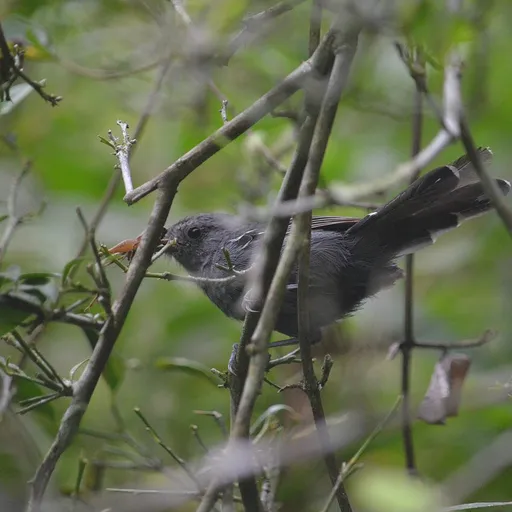
Rio de Janeiro Antbird
Cercomacra brasiliana
Least Concern
Overview
The Rio de Janeiro antbird (Cercomacra brasiliana) is a Near Threatened bird endemic to southeastern Brazil. It belongs to the subfamily Thamnophilinae within the family of typical antbirds. The species is a year-round resident throughout its range in secondary evergreen forests.
Identification
- Males are mostly gray with darker upperparts, a white patch between the scapulars, and blackish-gray tails with narrow white tips.
- Females have olive-brown upperparts, a whitish area around the eye, and bright ochraceous tawny underparts.
- The bird measures 13 to 14 cm in length, with wings that have a brown tinge in males and are darker than the back in females.
- Males sing 2–4 rapid, abrupt, barely audible notes followed by a longer harsh note, while females produce irregularly repeated notes sounding like 'cup'.
Habitat
Found in southeastern Brazil from southeastern Bahia south through eastern Minas Gerais and Espírito Santo into Rio de Janeiro state. It inhabits the dense understorey to mid-storey of secondary evergreen forest, particularly favoring areas with abundant tangles of vines. Elevation ranges from near sea level to about 950 m.
Diet
The diet is primarily insects and probably includes spiders, though specific details are not fully documented. Foraging occurs between 1 and 6 m above the ground, with individuals, pairs, or family groups hopping through vine tangles and dense vegetation. Prey is usually taken by gleaning and lunging from a perch, or through short flutter-flights.
Did you know?
Although presumably threatened by deforestation, the species shows resilience to forest fragmentation, likely due to its apparent tolerance of secondary habitats. It occasionally joins mixed-species feeding flocks passing through its territory but is not known to follow army ants.
Sources
- Wikipedia · CC BY-SA 4.0
- Wikidata · CC0 1.0