
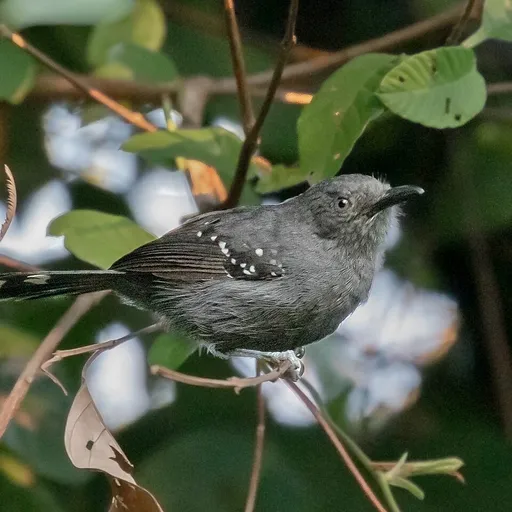
Grey Antbird
Cercomacra cinerascens
Least Concern
Listen
XC249903 · Niels Krabbe · Morona-Santiago: e-slope Cord. de Cutucú: Uuntsuants, Ecuador · CC BY-SA 4.0
Overview
The grey antbird (Cercomacra cinerascens) is a species of bird in the family Thamnophilidae, known as the typical antbirds. It is classified as Least Concern by the IUCN and is considered common throughout its extensive range in South America.
Identification
- Adults of the nominate subspecies have dark gray upperparts with a small white patch between the scapulars, while females possess olive-brown crowns and upperparts with a minimal white interscapular patch.
- The species is small, measuring 13 to 15 cm in length and weighing between 14 and 18 g.
- Males and females differ in song; males produce a 'sharp k-luck' while females emit a 'sharp zhip' and a low-pitched nasal growl.
- Subspecies C. c. sclateri features larger white interscapular patches and tail tips compared to the nominate, whereas C. c. iterata is paler overall.
Habitat
The grey antbird inhabits the dense vegetation of the mid-storey and subcanopy in terra firme evergreen forest, with a preference for areas rich in tangles of vines. Its range spans from near sea level up to approximately 900 m in most regions, though it reaches 1,150 m in Peru. It is a year-round resident found across Bolivia, Brazil, Colombia, Ecuador, French Guiana, Guyana, Peru, Suriname, and Venezuela.
Diet
The diet is primarily composed of insects and includes spiders, with individuals foraging between 8 and 20 m above the ground by gleaning and lunging from perches in vine tangles. They occasionally join mixed-species feeding flocks and have been observed briefly following Eciton burchelli army ant swarms in Brazil.
Did you know?
The specific epithet cinerascens is Late Latin for 'ashen', reflecting the bird's coloration, and the species was first described by Philip Sclater in 1857 from a specimen near the Rio Napo in Ecuador.
Sources
- Wikipedia · CC BY-SA 4.0
- Wikidata · CC0 1.0