
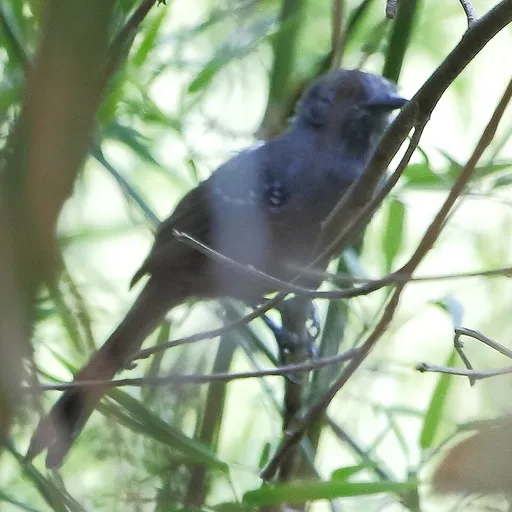
Manu Antbird
Cercomacra manu
Least Concern
Overview
The Manu antbird, scientifically known as Cercomacra manu, is a species of bird in the family Thamnophilidae, classified as 'typical antbirds'. It is considered a year-round resident throughout its range and is assessed as Least Concern by the IUCN, despite a believed decreasing population size.
Identification
- Adults range from 14 to 15.5 cm in length and weigh between 16 and 20 g.
- Males are predominantly very dark gray with paler gray on the face, flanks, and undertail coverts, while females feature an olive-brown crown and back with neutral gray underparts.
- Both sexes possess pale sandy brown irises, a black maxilla, a darkish-mottled silvery gray mandible, and pale gray legs.
- The male song consists of a slow series of deep, rich note pairs described as 'pook-CHA pook-CHA', to which females respond with deep 'kl'du' notes.
Habitat
Found in southeastern Peru, northern Bolivia, and western Brazil, the species has a disjunct distribution with smaller isolated populations in Amazonian Brazil. It inhabits stands of Guadua bamboo in partially shaded forest edges, such as along watercourses and roads, at elevations between 250 and 1,350 m. The species is considered uncommon to fairly common, though its population is believed to be decreasing.
Diet
The diet of the Manu antbird is primarily insects, although specific details are lacking. Pairs typically forage in the tops of bamboo stands and the canopy just above them, between 4 and 15 m above the ground. They hop through vegetation to glean prey while perched, occasionally hover-gleaning and joining mixed-species feeding flocks.
Did you know?
The only known nest of the Manu antbird is a pouch constructed from dead bamboo leaves and plant fibers, suspended from thin bamboo branchlets approximately 3.5 m above the ground. Additionally, because bamboo is a successional species that thrives in disturbed sites like roadways, the bird may locally benefit from low levels of habitat disturbance.
Sources
- Wikipedia · CC BY-SA 4.0
- Wikidata · CC0 1.0