
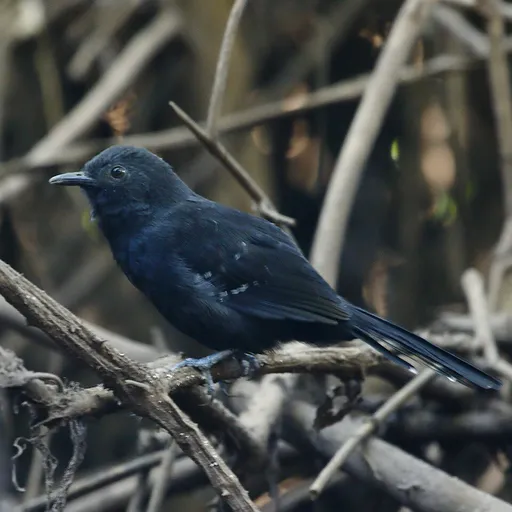
Mato Grosso Antbird
Cercomacra melanaria
Least Concern
Overview
The Mato Grosso antbird (Cercomacra melanaria) is a species of typical antbird found in Bolivia, Brazil, and Paraguay. Classified as Least Concern by the IUCN, it is a year-round resident that is considered locally common, particularly within the Pantanal region.
Identification
- Males are almost entirely black with white edges on outer scapulars, a white patch between them, and white-tipped wing coverts and tail feathers.
- Females possess olive-grey heads and upperparts with a white interscapular patch, dark grey wings and tails with white tips, and pale olive-grey underparts that whiten on the throat and breast.
- The bird measures 16 to 16.5 cm in length and weighs between 18.5 and 19.5 g.
- The male's song is a very low, dry, frog-like 'krokreéeh-tjow', often answered by a high, strident female 'chip-chip-'.
Habitat
This species primarily inhabits gallery forest, tropical deciduous forest, and seasonally flooded savanna woodlands, almost always near water, with a strong preference for dense understoreys tangled with vines. Part of the central Bolivian population also occurs in dry Chaco forest, and the bird is found at elevations up to 800 m.
Diet
The diet consists of insects and spiders, which are obtained by foraging from the ground up to 3 m, and occasionally 8 m, above the ground. Individuals, pairs, and family groups hop and flutter-fly among dense vegetation, taking prey by gleaning and lunging from a perch.
Did you know?
Although the species name derives from the Latin word for blackness, the male's plumage features subtle white edges and patches that are otherwise hidden. Its nest is a cup of fine fibers and dried leaves anchored to a branch using spider web, up to 15 ft above the ground.
Sources
- Wikipedia · CC BY-SA 4.0
- Wikidata · CC0 1.0