
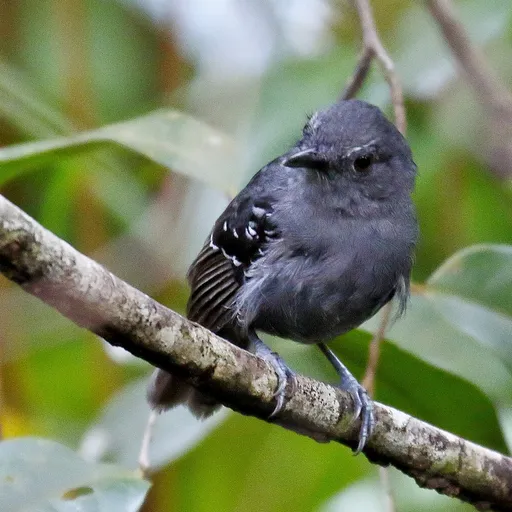
Willis's Antbird
Cercomacroides laeta
Least Concern
Overview
Willis's antbird, also known as the laeta antbird, is a species of bird in the family Thamnophilidae. It was formerly considered a subspecies of the dusky antbird but was elevated to full species status in 1997 due to distinct differences in plumage and voice.
Identification
- Males of the nominate subspecies are almost entirely gray with lighter underparts, featuring a white patch between the scapulars and narrow white tips on the wing coverts and outer tail feathers.
- Females have olive-gray upperparts and ear coverts, with tawny-buff throats and underparts that have an olive tinge to the flanks.
- The species is small, measuring 13.5 to 14.5 cm in length and weighing 15 to 17 g.
- The male song is described as a very high, short, and sharp 'puh-wéedi-wéedi-wéedih', with the 'wéedi' repeated two to five times.
Habitat
Found in Brazil and Guyana, the species inhabits the understorey at the edges of evergreen forest and mature secondary forest, usually near water. Subspecies ranges are disjunct, with C. l. waimiri in north-central Amazonian Brazil and southern Guyana, C. l. laeta in southeastern Amazonian Brazil, and C. l. sabinoi in the coastal eastern states of Pernambuco and Alagoas.
Diet
The diet consists of a variety of insects and spiders. Single birds, pairs, and family groups forage on the ground or within about 3 m of it, hopping through dense vegetation to glean, reach, or lunge at prey. The bird seldom joins mixed-species feeding flocks but occasionally attends army ant swarms.
Did you know?
The bird was named to commemorate the American ornithologist Edwin O'Neill Willis, and its status as a separate species was established by a 1997 study that highlighted its distinct voice and plumage.
Sources
- Wikipedia · CC BY-SA 4.0
- Wikidata · CC0 1.0