
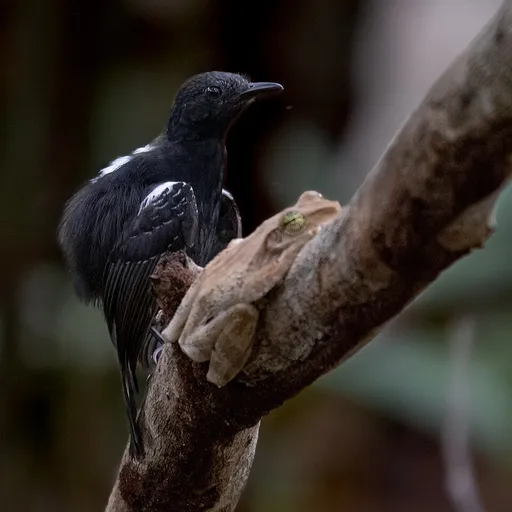
Black Antbird
Cercomacroides serva
Least Concern
Listen
XC248740 · Niels Krabbe · Sucumbíos: 'La Selva Jungle Lodge', n bank Río Napo, Ecuador · CC BY-SA 4.0
Overview
The black antbird (Cercomacroides serva) is a small passerine bird classified within the family Thamnophilidae, known as the typical antbirds. It is a year-round resident of the western Amazon Basin and adjoining Andean foothills, where it inhabits the understorey of evergreen forests.
Identification
- Length ranges from 13.5 to 15 cm with a weight of 15 to 17 g.
- Males are almost entirely blackish to dark gray, featuring a white patch between the scapulars, gray edges on flight feathers, and white tips on wing coverts.
- Females have an olive-tinged dark gray crown, upperparts, wings, and tail, with reddish brown to reddish yellow-brown underparts and a small white interscapular patch.
- Males sing a series of 4–7 sharp notes that rise in pitch and accelerate slightly, transcribed as "wor, chur, cheh-cheh-che-che-chi-chi-chi?".
Habitat
This species occupies the understorey of terra firme and várzea evergreen forests, transitional forests, and nearby mature secondary forest, typically at elevations up to 1,500 m. Its range extends from southern Colombia through eastern Ecuador and Peru into northwestern Bolivia and east into Brazil to the rios Juruá, Purus, and Madeira, with scattered records further east. It favors forest edges, densely vegetated openings, lake margins, and bamboo stands.
Diet
The black antbird feeds on a wide variety of insects and probably spiders, often foraging within about 2 m of the ground. It hops through dense vegetation, gleaning, reaching, lunging, and making short fluttery flights from perches to capture prey. While it seldom joins mixed-species feeding flocks, it has been observed attending army ant swarms in Ecuador.
Did you know?
The species possesses a notable ability to utilize a variety of second-growth habitats, which renders it less vulnerable to disturbance than many other antbirds. It is assessed as Least Concern by the IUCN, largely due to this adaptability and the presence of large expanses of intact habitat at little risk of near-future development.
Sources
- Wikipedia · CC BY-SA 4.0
- Wikidata · CC0 1.0