
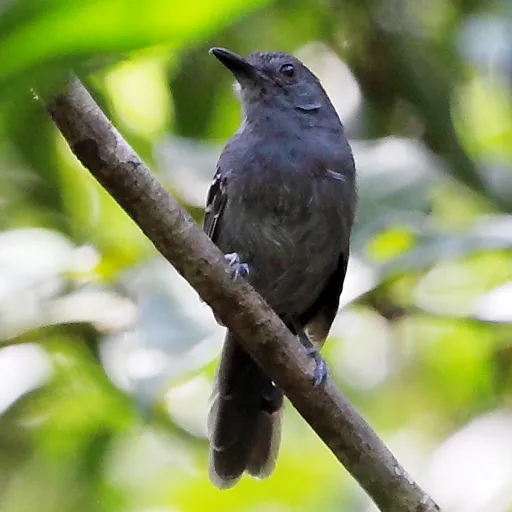
Dusky Antbird
Cercomacroides tyrannina
Least Concern
Listen
XC248184 · Niels Krabbe · Esmeraldas: 23 road km NNW Alto Tambo, 2 km N main road, Ecuador · CC BY-SA 4.0
Overview
The dusky antbird, or tyrannine antbird (Cercomacroides tyrannina), is a passerine bird belonging to the subfamily Thamnophilinae of the typical antbirds. It is a year-round resident found across a vast range, from southern Mexico through Central America into South America.
Identification
- Males of the nominate subspecies are mostly slate gray with darker wings and tail, featuring a white patch between the scapulars and narrow white tips on the wing coverts and outer tail feathers.
- Females possess a tawny-tinged dark olive-gray crown and upperparts, with a very small white interscapular patch and cinnamon-edged wing coverts.
- Adults of both sexes have a rich chocolate-brown iris.
- The male's song is a series of relatively short notes at even pitch and pace, described as "pü, pü, pee-pee-pipipi?", while the female's song consists of long notes rising in pitch followed by abrupt notes at the same pitch.
Habitat
This species inhabits the understorey of evergreen forest, overwhelmingly favouring forest edges, clearings, and the edges of watercourses, as well as secondary forest that borders taller, denser forest. It ranges in elevation from sea level up to 2,000 m in Colombia, though it is usually found below 1,200 m.
Diet
The dusky antbird feeds on a wide variety of insects and spiders, foraging primarily on the ground and within about 5 m of it, usually alone, in pairs, or in family groups. It typically hops through dense vegetation, taking prey by gleaning, reaching, lunging, and making short fluttery flights from a perch, and occasionally joins mixed-species feeding flocks or attends army ant swarms.
Did you know?
The species was formerly classified under the genus Cercomacra but was moved to the newly erected genus Cercomacroides after a 2014 molecular phylogenetic study revealed that Cercomacra was polyphyletic. Its ability to occupy second-growth thickets and forest edges renders it less vulnerable to disturbance than most other antbird species.
Sources
- Wikipedia · CC BY-SA 4.0
- Wikidata · CC0 1.0