
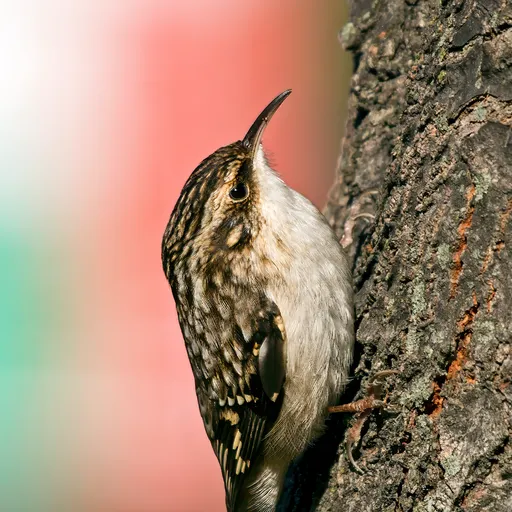
Brown Creeper
Certhia americana
Least Concern
Listen
XC1105993 · Doug Hynes · Big Glace Bay Lake National Wildlife Area, Nova Scotia, Canada · CC BY-SA 4.0
Overview
The brown creeper (Certhia americana), also known as the American treecreeper, is a small songbird and the only North American member of the treecreeper family Certhiidae. Classified as Least Concern on the IUCN Red List, this species is both migratory and a year-round resident across parts of North America, with a breeding range that extends from Canada and Alaska into the northeastern and western United States.
Identification
- Brown upperparts with light spotting that resemble tree bark, contrasting with white underparts.
- Long, thin bill with a slight downward curve and a long, stiff tail used for support.
- High-pitched, short, and insistent calls such as "see" or "swee," with songs described as having a cadence like "pee pee willow wee."
Habitat
Brown creepers prefer mature, moist coniferous or mixed coniferous/deciduous forests, generally avoiding the rainforest of the outer coast. They are year-round residents in much of their range, though northern populations migrate to the southern half of the United States for the non-breeding season. The species has a broad range across Canada, Alaska, and the United States, with occasional vagrancies to Bermuda and Central American mountains.
Diet
This species primarily eats small arthropods found in tree bark, though it occasionally consumes seeds during winter. Foraging behaviour involves creeping slowly up tree trunks in a zig-zag pattern with the body flattened against the bark, probing with the beak before flying down to the bottom of another tree to repeat the cycle.
Did you know?
In the dry season of January and February in El Salvador, brown creepers have been recorded breeding, a behaviour unusual for insectivorous birds in that region and shared locally only by the golden-fronted woodpecker.
Sources
- Wikipedia · CC BY-SA 4.0
- Wikidata · CC0 1.0