
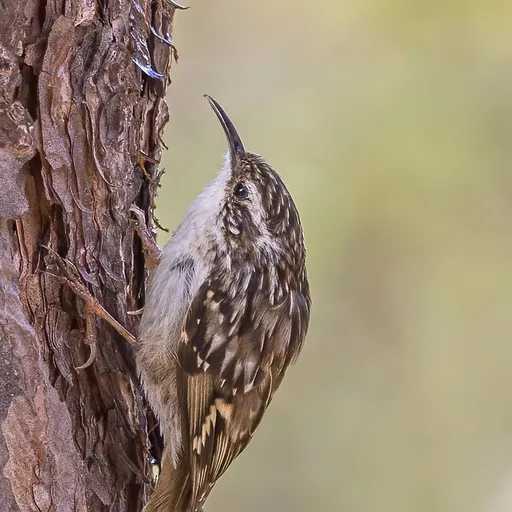
Short-toed Treecreeper
Certhia brachydactyla
Least Concern
Listen
XC730491 · Sonothèque ADVL · La Lucerne-d'Outremer, Manche, Normandie, France · CC0 1.0
Overview
The short-toed treecreeper (Certhia brachydactyla) is a small passerine bird found in woodlands across much of the warmer regions of Europe and into north Africa. It generally has a more southerly distribution than the common treecreeper, preferring deciduous trees and lower altitudes where their ranges overlap. Classified as Least Concern on the IUCN Red List, this species maintains a large population estimated between 4.1 and 14 million individuals.
Identification
- 12.5 cm in length with dull grey-brown upperparts intricately patterned with black, buff, and white, contrasting with whitish underparts and a white throat.
- Features a long, decurved bill and long, stiff tail feathers used for support while climbing, along with shorter toes than the common treecreeper.
- Call consists of a repeated shrill 'tyt...tyt tyt-tyt', while the song is an evenly spaced sequence of notes such as 'teet-teet-teet-e-roi-tiit', varying by region.
- Displays an erratic, undulating flight pattern alternating butterfly-like fluttering with side-slips and tumbles.
Habitat
This species breeds in temperate woodlands from Portugal to Turkey and Greece, extending into north-west Africa, with a preference for well-grown deciduous trees like oak. It typically inhabits lowlands but can breed at higher altitudes, such as up to 1,800 metres in France. Essentially non-migratory, it occasionally appears as a vagrant in areas like England, Sweden, and the Balearic Islands following post-breeding dispersal.
Diet
The bird feeds mainly on insects and spiders picked from tree trunks as it ascends with short hops, using its long, thin bill to extract prey from bark crevices. It typically starts at the base of a tree and spirals upwards, using its stiff tail for support before flying to the base of another tree. In colder months, it may supplement its diet with seeds.
Did you know?
Although normally solitary in winter, up to twenty or more birds will roost together in a suitable sheltered crevice or in a star formation under the eaves of buildings during cold weather. Despite its cryptic plumage and quiet call, the species is largely indifferent to the presence of humans and is considered unwary.
Sources
- Wikipedia · CC BY-SA 4.0
- Wikidata · CC0 1.0