
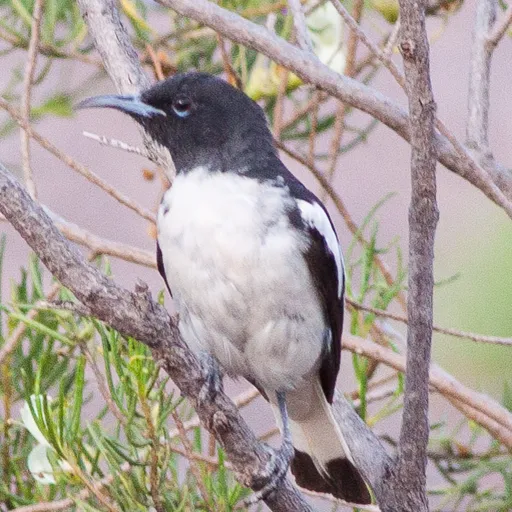
Pied Honeyeater
Certhionyx variegatus
Least Concern
Overview
The pied honeyeater (Certhionyx variegatus) is a mid-sized bird in the family Meliphagidae and the sole species in the genus Certhionyx. Also known as the black and white honeyeater, it is endemic to Australia and listed as a vulnerable species under Schedule 2 of the Threatened Species Conservation Act 1995 (NSW).
Identification
- Long curved bill with a small pale-blue patch of bare skin below the eye, which is semicircular in males and arc-shaped in females and juveniles.
- Males are black and white with a black head, neck and upper parts, white lower rump and upper tail, black wings with a white stripe, and white underparts with a black-tipped tail.
- Females are brown above with a grey-white chin, a whitish breast streaked and spotted dark-brown, white underparts and a white stripe along the edges of the secondary wing feathers.
- A mournful whistle resembling that of the little grassbird, and a melancholy piping note during the breeding season.
Habitat
The pied honeyeater is found in arid and semi-arid zones, on the sandhills of inland plains, inland ranges, granite outcrops, and coastal sandhills of Western Australia. It frequents shrublands and woodlands dominated by emu bush, grevilleas, mulga, and other species. Its range extends principally in a band below approximately 18° S, from central Queensland and central NSW across to the Western Australian coastline.
Diet
The pied honeyeater feeds primarily on nectar, but also eats insects, fruit and seeds, using its long bill to explore flowers and foliage of trees and shrubs, especially emu bush, eucalypts, and grevilleas. Stomach content analysis has revealed grape-like seeds, berries, grit, and insects and their larvae. It is classified as a summer drinker and has been recorded drinking on more than half of the days on which the temperature exceeded 25 degrees C.
Did you know?
During breeding displays, pairs sometimes fly into the air together and literally loop and loop, while a male may soar singing into the air from the top of a tree, suddenly dropping while turning over backward in its descent.
Sources
- Wikipedia · CC BY-SA 4.0
- Wikidata · CC0 1.0