
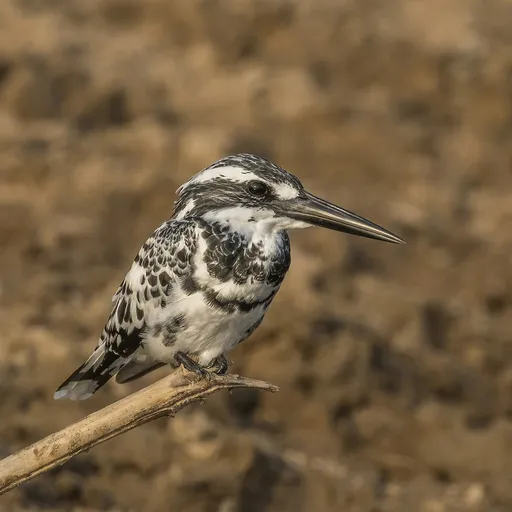
Pied Kingfisher
Ceryle rudis
Least Concern
Listen
XC513883 · Anne Ndung'u · Busiro, Wakiso, Central Region, Uganda · CC BY-SA 4.0
Overview
The pied kingfisher (Ceryle rudis) is a medium-sized water kingfisher widely distributed across Africa and Asia. It is the only member of the genus Ceryle and is one of the three most numerous kingfisher species in the world. The bird is classified as Least Concern by the IUCN Red List.
Identification
- Plumage: Distinctive black-and-white plumage with a neat crest, white supercilium, and black breast bands; males have a narrow second breast band, while females have a single broken band.
- Size: Approximately 25 cm long.
- Bill: Subspecies C. r. insignis in southeastern China and Hainan is noted for having a much larger bill.
- Behaviour: Often bobs its head up and down and flicks its tail upwards when perched; produces sharp 'chirruk chirruk' calls.
Habitat
Found in pairs or small family groups in clear lakes and rivers across sub-Saharan Africa and southern Asia, ranging from Turkey to India and China. It is a resident species that rarely migrates, though short-distance seasonal movements occur. In India, it is mainly found on the plains, while higher hills are occupied by the crested kingfisher.
Diet
Feeds primarily on fish, but also takes crustaceans and large aquatic insects such as dragonfly larvae. It typically hovers over water to detect prey before diving vertically, bill-first, to capture it. Notably, it can manipulate and swallow prey in flight without returning to a perch, allowing it to hunt in estuaries lacking perches.
Did you know?
The pied kingfisher is quite gregarious, forming large roosts at night. In India, it sometimes exhibits cooperative breeding, where young, non-breeding birds assist parents or even unrelated older birds in raising a brood.
Sources
- Wikipedia · CC BY-SA 4.0
- Wikidata · CC0 1.0