
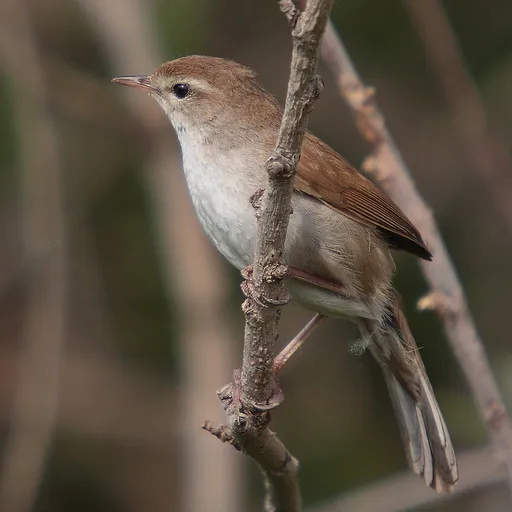
Cetti's Warbler
Cettia cetti
Least Concern
Listen
XC1059282 · Lionel Triboulin · Hérault, Lansargues, France · CC0 1.0
Overview
Cetti's warbler (Cettia cetti) is a small, brown warbler in the family Cettiidae that breeds in southern and western Europe, northwest Africa, and the east Palearctic. The species, which is often difficult to see due to its skulking habits, is named after the 18th-century Italian zoologist Francesco Cetti.
Identification
- Measures approximately 13–14 cm in length, with males weighing up to 15 g and females up to 12 g.
- Upperparts are a rich chestnut or dark reddish-brown, contrasting with pale grey-brown throat and breast.
- Features a rounded head with a narrow pale grey stripe arching over conspicuous black eyes, and short, rounded wings.
- Possesses a longer and broader tail than many other warblers and is unusual among passerines in having ten tail feathers rather than the usual twelve.
- Signals its presence with a loud, distinct song that comes in bursts.
Habitat
The bird usually inhabits thick shrubby vegetation in damp areas close to, but not in, ponds, lakes, marshes, and rivers. Its range extends from west Europe and northwest Africa to the east Palearctic, reaching as far as Afghanistan and northwest Pakistan.
Diet
Cetti's warbler is insectivorous, preying on arthropods such as small, soft-bodied insects and larvae. The species prefers tiny insects because they can be digested faster.
Did you know?
Cetti's warblers are unusual among passerine birds in having ten tail feathers (rectrices) rather than the standard twelve.
Sources
- Wikipedia · CC BY-SA 4.0
- Wikidata · CC0 1.0