
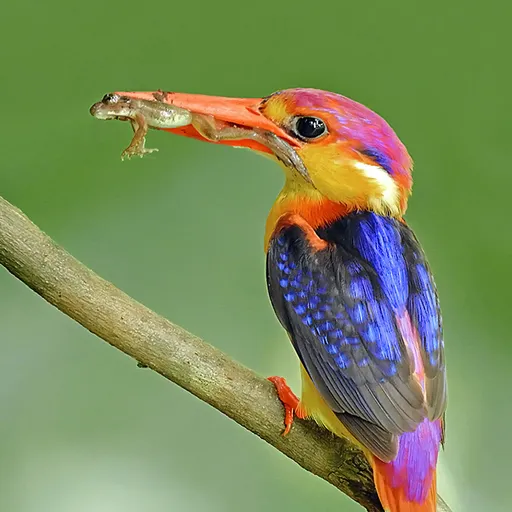
Black-backed Dwarf Kingfisher
Ceyx erithaca
Near Threatened
Overview
The black-backed dwarf kingfisher (Ceyx erithaca), also known as the three-toed kingfisher, is a pocket-sized bird in the family Alcedinidae. It is a partial migrant endemic to parts of the Indian Subcontinent and Mainland Southeast Asia. This species is classified as Near Threatened on the IUCN Red List due to habitat loss.
Identification
- Measures 12.5–14 cm in length with females weighing 14–16g and males 14–21.5g.
- Features a red bill and legs, a blue-black back, lilac-rufous crown and rump, and pale yellow-orange underparts.
- Both sexes have a black spot on the forehead and blue and white patches on the side of the neck.
- Vocalisation consists of a high-pitched, shrill "tsriet-tsriet" or soft "tjie-tjie-tjie" in flight.
Habitat
This species resides in lowland forests, typically near streams or ponds, within an elevation range that does not usually exceed 1000–1300m. It is found in deciduous and evergreen primary and secondary forests, as well as alluvial forests, mangroves, and dense aggregations of palms, bamboos, or shrubs. The breeding range includes eastern Bangladesh, northeastern India, Myanmar, the extreme south of China, Laos, Cambodia, and Thailand, with disjunct populations in the Western Ghats of western India and Sri Lanka.
Diet
The diet consists primarily of insects such as mantises, grasshoppers, flies, water beetles, winged ants, and mayflies, along with spiders, worms, and small crabs, fish, frogs, and lizards. Foraging is solitary, involving perching in low vegetation or on rocks before flying out to capture prey from the ground or foliage. They can take spiders from webs, catch insects in flight, and dive into water for prey at or just below the surface without submerging themselves.
Did you know?
The species is sometimes called the three-toed kingfisher because it has only three toes, although this toe count is not adaptive and is shared by other kingfisher species. Its specific epithet, erithaca, is derived from the Latin for 'robin', meaning 'red-breasted', referencing the account that was originally used to describe it.
Sources
- Wikipedia · CC BY-SA 4.0
- Wikidata · CC0 1.0