
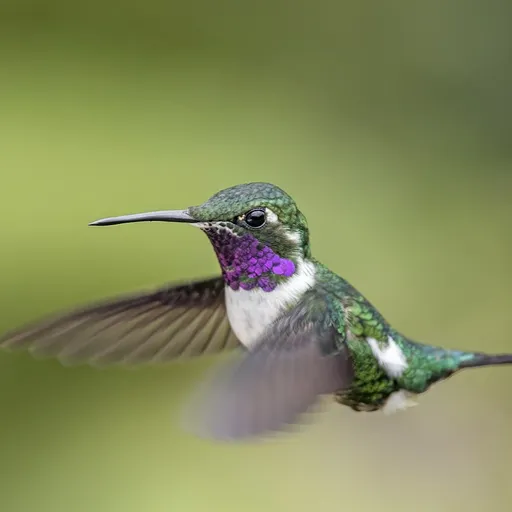
White-bellied Woodstar
Chaetocercus mulsant
Least Concern
Listen
XC250617 · Niels Krabbe · Zamora-Chinchipe: Reserva Tapichalaca, Ecuador · CC BY-SA 4.0
Overview
The white-bellied woodstar (Chaetocercus mulsant) is a small species of hummingbird classified within the tribe Mellisugini, commonly referred to as the 'bee hummingbirds'. It is considered a species of Least Concern by the IUCN, with a population believed to be stable across its range.
Identification
- Males possess dark bluish-green upperparts and flanks, an iridescent reddish-violet gorget, and a white belly, with a downcurving white line behind the eye.
- Females are bronzier green above, feature a greyish mask and buff stripe behind the eye, and have a pale cinnamon throat.
- Both sexes are approximately 8.5 cm long and weigh between 3.8 and 4 g, sporting a straightish black bill.
- Vocalisations include a low-pitched 'djup' note and a higher-pitched, dull 'chip'.
Habitat
Found in the Central and Eastern Andes of Colombia, extending discontinuously south through Ecuador and Peru into Bolivia as far as the Cochabamba Department. The species inhabits the edges of humid forest, pastures, and cultivated areas, typically between elevations of 2,200 and 2,800 m, though it can occur as low as 1,500 m or as high as 4,000 m.
Diet
This hummingbird forages at all levels of vegetation, consuming nectar from diverse flowering plants and trees such as Agave, Inga, and Lantana, along with small arthropods. It does not defend feeding territories and, owing to its small size and slow, bumblebee-like flight, is capable of feeding within the territories of other hummingbird species.
Did you know?
The white-bellied woodstar is often overlooked and may be more common than generally assumed due to its small size and slow, bumblebee-like flight. It is also noted for its ability to adapt to human-made landscapes.
Sources
- Wikipedia · CC BY-SA 4.0
- Wikidata · CC0 1.0