
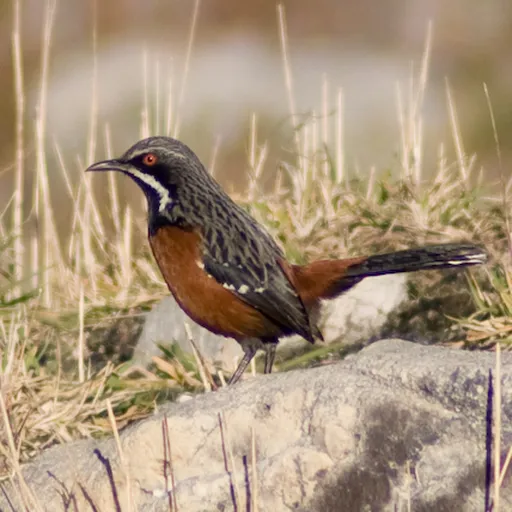
Cape Rockjumper
Chaetops frenatus
Near Threatened
Overview
The Cape rockjumper is a medium-sized insectivorous passerine bird endemic to the mountain Fynbos of southernmost South Africa. Classified as Near Threatened on the IUCN Red List, this species is an alpine habitat specialist that faces declining numbers in warmer parts of its range due to low heat tolerance.
Identification
- Length of 23–25 cm with strong legs, a long black tail, and proportionately small wings.
- Males have a dark grey and black head with a thin white supercilium and a broad white moustache, dark grey back and wings, and rufous red underparts and rump.
- Females and juveniles possess paler grey upperparts, duller head patterns, orange rumps, and buff underparts.
- Bright red eyes in adults, contrasting with black eyes in juveniles.
- Calls vary from one to four piercing whistles to a series of trills.
Habitat
Cape rockjumpers inhabit only mountain Fynbos, specifically low scrubby restio vegetation on steep slopes with plenty of large boulders. Their range extends from Cape Town to Port Elizabeth in South Africa, covering an alpine habitat area of 90,000 hectares, with one established population at sea level at Rooi-Els.
Diet
These birds forage on rocky slopes and scree, spending most of their lives running and jumping among rocks and grasses to hunt arthropods, small lizards, and amphibians. While insects such as caterpillars, moths, grasshoppers, beetles, and flies form the major part of their diet, they also consume lizards, geckos, amphibians, scorpions, annelid worms, and spiders.
Did you know?
Nests built by Cape rockjumpers are lined with fur from red rock hares or old, fluffy protea seed pods. Nest success is higher in territories that have experienced fire within the previous 3–5 years, likely because fewer predators are present in recently burnt areas.
Sources
- Wikipedia · CC BY-SA 4.0
- Wikidata · CC0 1.0