
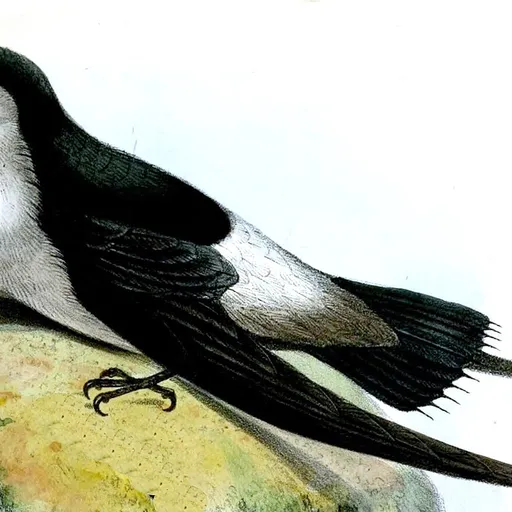
Grey-rumped Swift
Chaetura cinereiventris
Least Concern
Listen
XC250621 · Niels Krabbe · Napo: km 11.6 Narupa-Loreto road, Ecuador · CC BY-SA 4.0
Overview
The grey-rumped swift (Chaetura cinereiventris) is a species of bird in the family Apodidae, widely distributed across Central and South America. It is assessed as a species of Least Concern on the IUCN Red List, with an estimated population of 50 million mature individuals.
Identification
- Approximately 10.5 cm long and weighing about 17 g, featuring a protruding head, a short square tail, and wings that bulge in the middle and hook at the ends.
- Adults of the nominate subspecies display glossy black upperparts with a wide gray rump and uppertail coverts, while underparts are a lighter gray, darkening on the undertail coverts.
- Vocalisations include a bright repeated short 'tsip' and a series of 3–4 slightly downslurred burry drawn-out notes like 'trrreeew-trrreeew-trrreeew'.
Habitat
This species inhabits a variety of landscapes, including lowland and montane tropical evergreen forests, seasonally flooded forests, and secondary forest. Its range extends from Honduras and Nicaragua through South America (excluding Chile, French Guiana, Suriname, and Uruguay) to Trinidad and Tobago and Grenada, covering elevations from sea level to 1,800 m.
Diet
As an aerial insectivore, the grey-rumped swift feeds on flying ants, bees, wasps, beetles, and flies. It typically forages in flocks of 20 to 40 birds, which may consist of the species alone or mixed with other swifts and swallows.
Did you know?
The bird constructs a half-cup nest on the vertical interior wall of a chimney or similar structure, which may be rebuilt and reused for breeding.
Sources
- Wikipedia · CC BY-SA 4.0
- Wikidata · CC0 1.0