
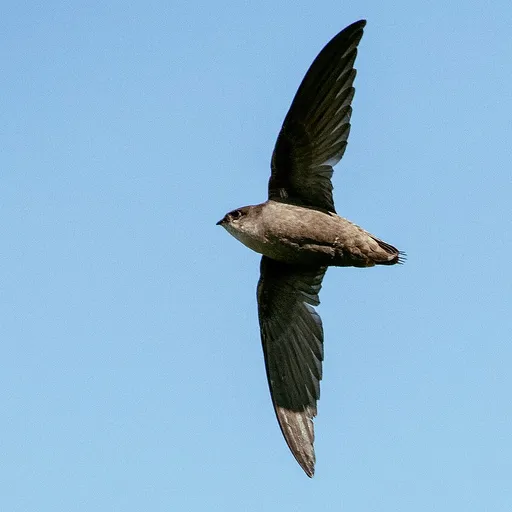
Chimney Swift
Chaetura pelagica
Vulnerable
Listen
XC796218 · steve · Chapel Hill, Orange County, North Carolina, United States · CC BY-SA 4.0
Overview
The Chaetura pelagica is a medium-sized bird in the swift family Apodidae that is currently classified as Vulnerable on the IUCN Red List. It is a widespread breeding visitor to much of the eastern half of the United States and the southern reaches of eastern Canada, where it has adapted remarkably to human environments by nesting in artificial structures such as chimneys.
Identification
- Plumage: Dark sooty olive above and greyish brown below, with a slightly paler rump and a significantly paler throat.
- Structure: Measures 12–15 cm in length with a wingspan of 27–30 cm; features long, slender wings that extend beyond the tail and very short legs.
- Bill: Very small with a 5 mm culmen, but possesses a huge gape that extends below the eyes.
- Call: Produces a twittering call consisting of a rapid series of hard, high-pitched chirps.
- Similar Species: Similar to Vaux's swift but slightly larger with slower wingbeats and darker breast and rump; smaller and paler than the black swift.
Habitat
Found over open country, savanna, wooded slopes, and humid forests. It breeds widely across the eastern United States and eastern Canada, migrating to South America for the winter, with rare summer occurrences in the western U.S. and vagrant records in locations such as the United Kingdom and Greenland.
Diet
Feeds primarily on flying insects, comprising 95 percent of its diet, including flies, ants, wasps, and bees, as well as airborne spiders. It forages on the wing, often in small groups, and can glean food from tree foliage by hovering near branch ends or dropping through the upper canopy levels.
Did you know?
Its genus name, Chaetura, is derived from Ancient Greek words for 'bristle' and 'tail', aptly describing its tail feathers, which have shafts that extend sharply beyond the vanes to help it prop itself against vertical surfaces. While it was historically believed to belong to the swallow family due to its appearance, it is now known to be incapable of perching on flat surfaces.
Sources
- Wikipedia · CC BY-SA 4.0
- Wikidata · CC0 1.0