
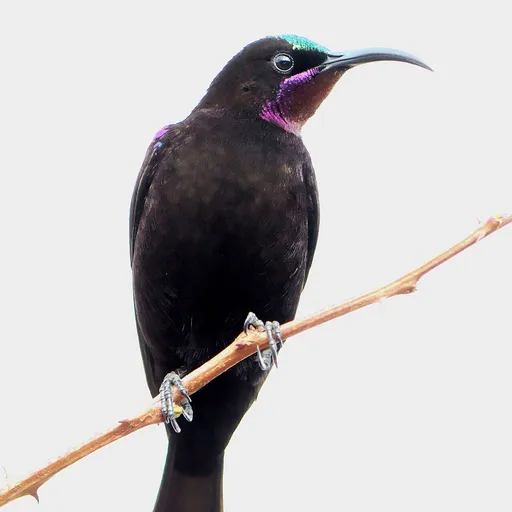
Amethyst Sunbird
Chalcomitra amethystina
Least Concern
Overview
The amethyst sunbird, also known as the black sunbird (Chalcomitra amethystina), is a passerine bird in the family Nectariniidae native to the Afrotropics, primarily south of the equator. It is currently listed as Least Concern on the IUCN Red List, though local populations have been impacted by the loss of woodlands.
Identification
- Males possess metallic purple tail coverts in the nominate race, while females are dark from the throat to the belly in that subspecies.
- The bill is described as heavy in the nominate race but finer in the kirkii race.
- The complex song is characterised by a loud, sustained twittering.
- Courtship involves the male hopping on a branch and dropping one wing, then the other, followed by fluttering and displaying both wings.
Habitat
These birds are widespread residents of woodland, mesic savanna, forest edge, and suburban gardens across a range that includes Angola, South Africa, and parts of East and Central Africa. They prefer well-watered habitats and undertake seasonal movements to visit flowering woodlands, such as the Kalahari sand woodlands where they are strictly summer visitors. They are scarce in dry savannas but common in riparian woods and afromontane forests up to 1,800 metres.
Diet
Their diet consists of emergent termites, spiders, and nectar. They are commonly found singly or in pairs but may concentrate in larger numbers at favourite flowering trees, where they act aggressively towards other sunbird species.
Did you know?
The Amethyst Sunbird possesses an average hematocrit level of 50%, which is significantly higher than the 30 to 45% average found in most other birds. This adaptation, which increases with altitude during warmer months, helps with oxygen carrying capacity and reduces the metabolic cost of flying.
Sources
- Wikipedia · CC BY-SA 4.0
- Wikidata · CC0 1.0