
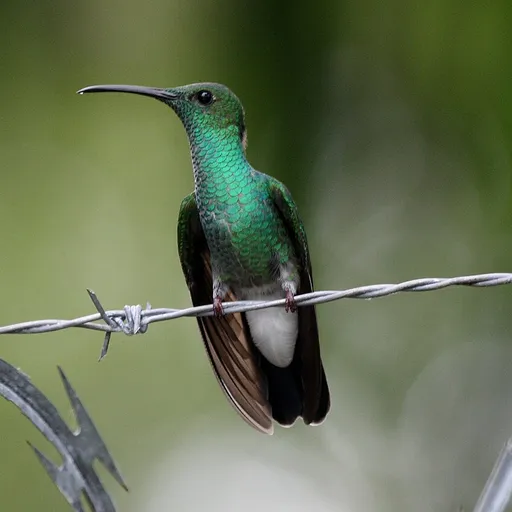
White-vented Plumeleteer
Chalybura buffonii
Least Concern
Overview
The white-vented plumeleteer, Chalybura buffonii, is a species of hummingbird found across parts of Central and South America. It is classified as Least Concern by the IUCN, with an estimated population of at least 500,000 mature individuals, although this number is believed to be decreasing.
Identification
- A small hummingbird measuring 10.5 to 12 cm in length, with males weighing 6 to 7.3 g and females 5.9 to 7.9 g.
- Males of the nominate subspecies display dark metallic green upperparts with a bronzy crown and coppery bronze uppertail coverts, while females are paler above and gray below with green speckles.
- Most subspecies possess a black bill and black feet, though the intermedia subspecies has a pinkish bill base and pale pink to red feet.
- Makes short "chip" notes while foraging, though its song has not been otherwise described.
Habitat
The species inhabits a wide variety of landscapes, including the edges and interiors of dry, moist, and wet forests, as well as semi-open woodlands, secondary forest, and scrublands. Its range spans from sea level to 2,000 m across Colombia, Ecuador, Panama, Peru, and Venezuela.
Diet
This bird forages for nectar from flowering plants ranging from the understory to the canopy, typically by trap-lining but also aggressively defending rich patches. It supplements its diet with small arthropods caught by hawking from a perch, hovering, or gleaning from vegetation and spider webs.
Did you know?
The bird constructs its nest from a cup of plant down bound with spiderweb and decorated with moss and lichen on the outside. These nests have been found on tree branches as high as 2.5 m above the ground.
Sources
- Wikipedia · CC BY-SA 4.0
- Wikidata · CC0 1.0