
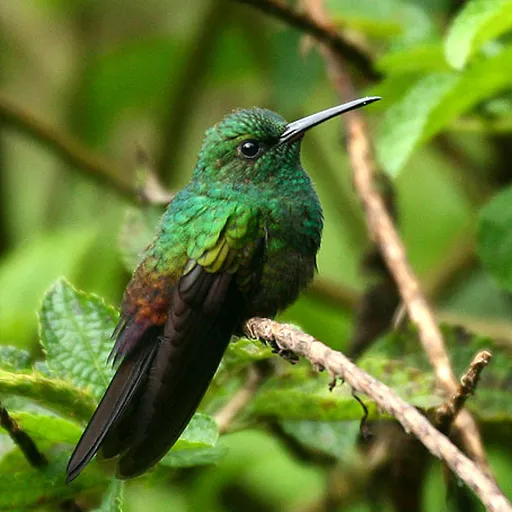
Bronze-tailed Plumeleteer
Chalybura urochrysia
Least Concern
Overview
The bronze-tailed plumeleteer is a small hummingbird species within the tribe Trochilini of the subfamily Trochilinae. It is found across parts of Central America, including Colombia, Costa Rica, Ecuador, Nicaragua, and Panama.
Identification
- Length is between 10.5 and 12 cm, with males weighing approximately 7.1 g and females around 6.1 g.
- Males of the nominate subspecies feature metallic green upperparts and underparts, bronze-green tails, and long fluffy white undertail coverts; females are metallic green above with gray underparts marked with green flecks.
- Both sexes possess a black maxilla and mandible tip, with the rest of the mandible ranging from dull pink to dark red.
- Song is described as a soft, nasal, scratchy trilled phrase resembling 'ter-twee-ee-ee-ee-ee', accompanied by loud 'chup' and 'chip' notes when chasing.
Habitat
The species inhabits the interior and edges of humid forests, mature secondary forests, and semi-open landscapes such as banana plantations and gardens, while avoiding open areas. Its elevation range extends from sea level to 700 m in Costa Rica and up to 900 m in Colombia.
Diet
This bird forages for nectar from the understory to the mid-strata and visits epiphytes in the sub-canopy, showing a particular preference for Heliconia. It also captures small arthropods by hawking from perches or gleaning from foliage.
Did you know?
The bronze-tailed plumeleteer aggressively defends patches of Heliconia and other rich nectar sources. Its nest is a deep cup constructed from pale plant down and fibers, bound with spiderweb and concealed on the outside with moss and lichen.
Sources
- Wikipedia · CC BY-SA 4.0
- Wikidata · CC0 1.0