
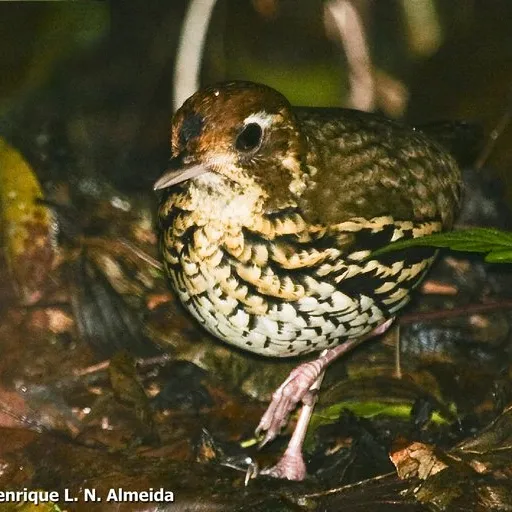
Short-tailed Antthrush
Chamaeza campanisona
Least Concern
Listen
XC249380 · Niels Krabbe · Napo: km 11.6 Narupa-Loreto road, Ecuador · CC BY-SA 4.0
Overview
The short-tailed antthrush (Chamaeza campanisona) is a species of bird in the family Formicariidae found across mainland South America, excluding Chile, French Guiana, and Uruguay. It is classified as Least Concern by the IUCN, with a very large range, though its population is believed to be decreasing despite no immediate threats being identified.
Identification
- Size 19 to 25 cm long and weighing 64 to 112 g, with sexes appearing alike.
- Plumage features include a rufescent brown or brown crown with a black spot on the forecrown, white lores, and a white streak behind the eye.
- Underparts are rich buff with wide black streaks on the breast and flanks, alongside black bars or spots on the crissum.
- Song varies by region but often consists of ventriloquial, trogon-like notes that accelerate and rise before abruptly shifting into descending popping sounds, with calls including sharp 'quock' or 'quoak' notes.
Habitat
The short-tailed antthrush inhabits humid foothill and montane forests and woodlands throughout its highly disjunct ranges, occurring between 450 and 2,800 m in elevation across various South American countries. In eastern Brazil, it also occurs in lowland evergreen forest at elevations between sea level and 1,500 m on the tepuis.
Diet
The species is almost entirely terrestrial, foraging by walking slowly and deliberately through thick vegetation and along roots and logs while pumping its tail. Although its diet is not fully known, it is assumed to eat mostly insects and other arthropods, and perhaps also small vertebrates, often foraging apart from army ants despite occasionally following them.
Did you know?
The specific epithet campanisona is derived from the Latin words 'campana' and 'sonus', meaning 'bell' and 'sound', a direct reference to the bird's distinctive bell-like song.
Sources
- Wikipedia · CC BY-SA 4.0
- Wikidata · CC0 1.0