
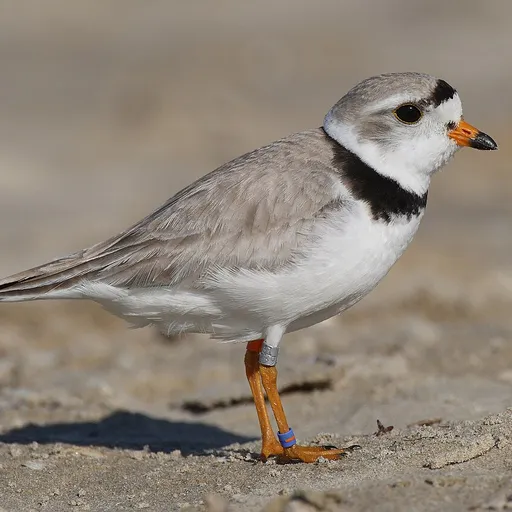
Piping Plover
Charadrius melodus
Near Threatened
Overview
The piping plover (Charadrius melodus) is a small, sand-colored shorebird that nests and feeds along coastal sand and gravel beaches in North America. It is classified as Near Threatened on the IUCN Red List and was listed as endangered in the Great Lakes region by the U.S. Fish & Wildlife Service in 1986.
Identification
- Stout, sparrow-sized bird ranging from 15–19 cm in length with a large rounded head, short thick neck, and stubby bill.
- Sand-colored, dull gray/khaki plumage that blends well with open, sandy habitats, making the bird difficult to see when standing still.
- Adults possess yellow-orange legs and a black band across the forehead; males display a prominent black breast band during breeding, which is usually thicker than that of females.
- Emits a plaintive, bell-like whistle that is frequently heard before the bird is visible, along with a soft, whistled 'peep peep' and a two-syllable alarm call.
Habitat
Piping plovers reside on open sandy beaches or rocky shores, typically in high, dry sections away from water along the Atlantic Coast of the U.S. and Canada, as well as on the shores of the Great Lakes. They are considered disturbance-dependent species, relying on habitats that are periodically flooded to bring in fresh sand and clear vegetation, a dynamic that natural coastal management has increasingly disrupted. During winter, they migrate to the Gulf of Mexico, the southern Atlantic coast, and the Caribbean, including The Bahamas.
Diet
The piping plover forages on beaches by sight, moving in short bursts to consume mainly insects, marine worms, and crustaceans. They typically feed around the high tide wrack zone and along the water's edge.
Did you know?
In contrast to most species that suffer from habitat loss, piping plovers are known to nest in waste sand piles generated by nearby mines, as these areas mimic the open, vegetation-free sand bars they require. Additionally, the species was historically plucked for its feathers, which were used as decorations in women's hats, a practice that contributed significantly to its initial population decline.
Sources
- Wikipedia · CC BY-SA 4.0
- Wikidata · CC0 1.0