
Semipalmated Plover
Charadrius semipalmatus
Least Concern
Listen
XC1033230 · Doug Hynes · Country Island National Wildlife Area, Nova Scotia, Canada · CC BY-SA 4.0
Overview
The semipalmated plover (Charadrius semipalmatus) is a small plover species classified as Least Concern on the IUCN Red List. Its specific name, semipalmatus, references its partially webbed feet, a feature also noted in its English common name.
Identification
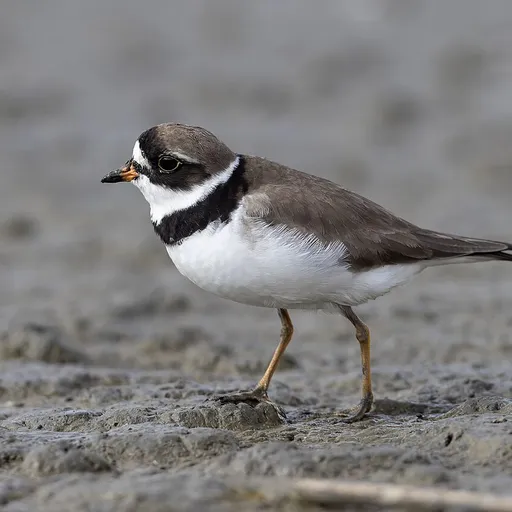
- Adults display a grey-brown back and wings, a white belly, and a white breast marked by a single black neckband.
- Head features include a brown cap, white forehead, and a black mask surrounding the eyes.
- Measures 17–19 cm in length with a mean wing length of 12–13 cm.
- Possesses a short bill that is orange and black.
Habitat
Breeding occurs on open ground on beaches or flats with little vegetation across northern Canada and Alaska. As a migratory species, it winters in the coastal areas of the southern United States, the Caribbean, and much of South America. It is an extremely rare vagrant to western Europe, though its status may be obscured by its similarity to the Eurasian ringed plover.
Diet
Forages on beaches, tidal flats, and fields, usually by sight, consuming insects, spiders, crustaceans, worms, and small molluscs. It is an opportunistic feeder that also consumes berries or seeds from grasslands and cultivated fields.
Did you know?
To protect its ground nest, the bird employs a 'broken-wing' display to lure intruders away, a behaviour similar to that of the related killdeer.
Sources
- Wikipedia · CC BY-SA 4.0
- Wikidata · CC0 1.0