
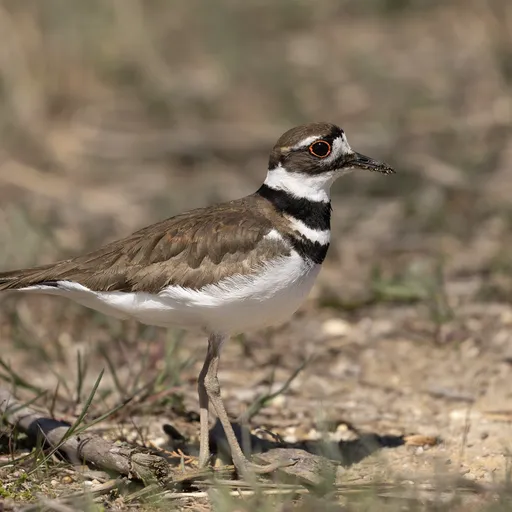
Killdeer
Charadrius vociferus
Near Threatened
Listen
XC1032639 · Doug Hynes · Goulds, Newfoundland and Labrador, Canada · CC BY-SA 4.0
Overview
The killdeer (Charadrius vociferus) is a large plover native to the Americas, known for its distinct two-syllable call. Classified as a near-threatened species on the IUCN Red List, it maintains a broad range across North and South America.
Identification
- Plumage: Upperparts are mostly brown with rufous fringes; features a white forehead, white stripe behind the eye, and black lores.
- Markings: The breast is white with two black bands, a trait unique to it among North American plovers; the rump is bright red.
- Structure: Tall and slender body with a relatively long tail, a short, thick, dark bill, flesh-coloured legs, and a red eye ring.
- Vocalisation: A shrill, two-syllable cry sounding like 'kill-deer', often repeated as 'kee-deeyu' during display flights.
Habitat
Breeding grounds consist of open fields with short vegetation, including agricultural land and meadows, though it occasionally nests on rooftops. During the non-breeding season, it occupies coastal wetlands, beach habitats, and coastal fields. Its range extends from southeastern Alaska and southern Canada through Mexico to Peru, with some populations resident in the southern half of the breeding range.
Diet
Primarily feeds on insects such as beetles and flies, supplemented by millipedes, worms, snails, spiders, and seeds. Forages almost exclusively in fields, particularly those with short vegetation and standing water, often following ploughs to catch disturbed earthworms. Forages at night during the non-breeding season when the moon is full to exploit increased insect abundance.
Did you know?
The killdeer can be observed 'foot-trembling' in shallow water, standing on one foot while shaking the other to stir up prey before pecking. Its defensive 'broken-wing display' can be so effective at distracting predators that it occasionally results in the death of the performing individual.
Sources
- Wikipedia · CC BY-SA 4.0
- Wikidata · CC0 1.0