
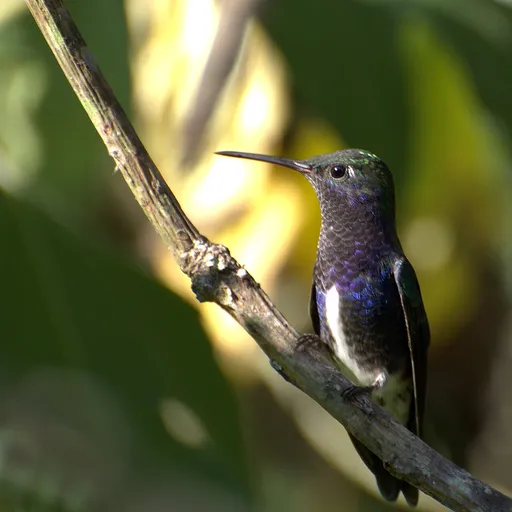
Sapphire-spangled Emerald
Chionomesa lactea
Overview
The sapphire-spangled emerald (Chionomesa lactea) is a small hummingbird belonging to the tribe Trochilini. It comprises three subspecies with distinct ranges across South America and is noted for its vibrant plumage and territorial behaviour.
Identification
- Length of 8 to 11 cm with a medium-length straight bill featuring a blackish maxilla and a pinkish or horn-coloured mandible.
- Males of the nominate subspecies display golden- to bronze-green upperparts, with a glittering violet-blue throat and upper breast that transitions to a white lower breast center.
- Females resemble males but possess a grayish throat speckled with glittering turquoise spots and grayish tips on the outermost tail feathers.
- Song consists of a repeated buzzy, insect-like high-pitched trill described as 'tzee' or 'tzitzitzee', accompanied by 'tsip' and 'chup' call notes.
Habitat
Found in semi-open landscapes such as rainforest edges, gallery forest, secondary forest, river edges, and clearings, typically below 1,000 m, though C. l. zimmeri in Venezuela occurs between 1,100 and 1,400 m. The nominate subspecies also frequents open cerrado, campos rupestres, parks, and gardens. Its range extends across Bolivia, Brazil, Peru, and Venezuela, with vagrant records in Argentina and hypothetical presence in Ecuador.
Diet
Forages for nectar from a wide variety of native and introduced flowering plants, shrubs, and trees, favouring families such as Leguminaceae, Malvaceae, and Bromeliaceae. Males defend feeding territories and also feed on insects caught by hawking from a perch.
Did you know?
The sapphire-spangled emerald is depicted on the reverse side of the discontinued 1-Brazilian Real banknote.