
Blue-backed Manakin
Chiroxiphia pareola
Least Concern
Listen
XC249557 · Niels Krabbe · Pastaza: Churunalpi, 5 km N Canelos, Ecuador · CC BY-SA 4.0
Overview
The blue-backed manakin (Chiroxiphia pareola) is a small passerine bird that breeds in tropical South America and Tobago. It is a fairly common species within its range, and the International Union for Conservation of Nature has rated its conservation status as being of 'least concern'.
Identification
- Compact, plump bird approximately 13 cm long and weighing 19 g.
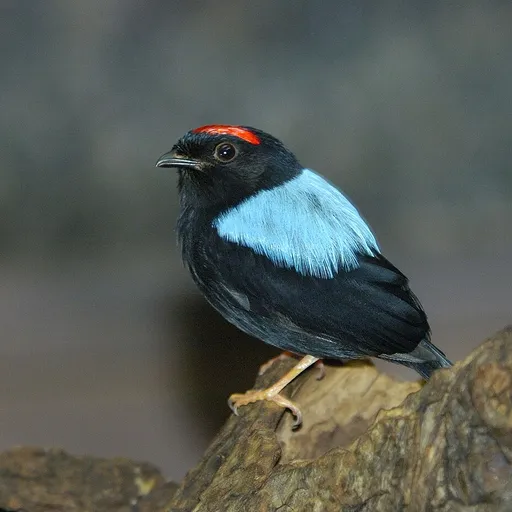
- Males are mainly black with a bright blue back, pale orange legs, and a crown that is typically red, though yellow in the south-west Amazon race C. p. regina.
- Females and juveniles possess olive-green upperparts with somewhat paler olive underparts.
- The race endemic to Tobago, C. p. atlantica, is larger and displays more extensive red on the crown and blue on the back.
Habitat
The species inhabits dry and moist deciduous forests but is absent from evergreen rainforests. Its range extends across southern Colombia, eastern Venezuela, the Guyanas, and the Amazon Basin in Brazil, Bolivia, Ecuador, and Peru, with a disjunct population on the coastal strip of southeast Brazil. It is notably absent from the northwest Amazon Basin, a region stretching from central Venezuela to the southern border of Colombia.
Diet
The blue-backed manakin feeds on fruit and some insects.
Did you know?
The breeding display is a cooperative rather than competitive affair, with groups of up to eight birds performing together where two males perch on bare sticks and jump alternately to create a vertical circling movement when a female approaches. This unusual social behaviour is accompanied by a buzzing call during the display.
Sources
- Wikipedia · CC BY-SA 4.0
- Wikidata · CC0 1.0