
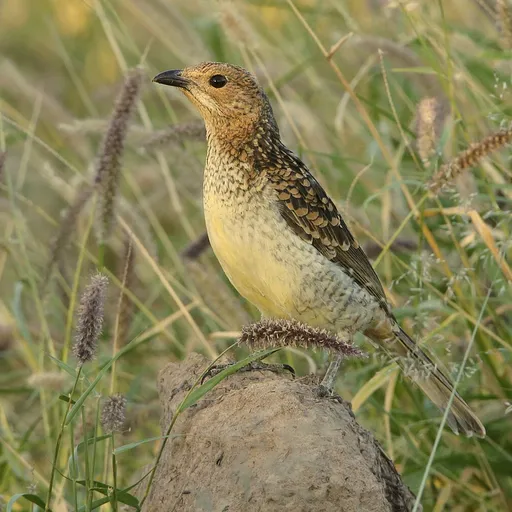
Spotted Bowerbird
Chlamydera maculata
Least Concern
Overview
The spotted bowerbird (Chlamydera maculata) is a sedentary, mid-sized passerine found across broad parts of the drier habitats of eastern Australia. It is well known for its complex bower building, elaborate courtship displays and remarkable vocal mimicry.
Identification
- Size: 29 cm long, intermediate among bowerbirds, but rather slim and compact.
- Plumage: Sexually monomorphic with a pale rufous head streaked grey-brown and a lilac-pink nuchal crest; upperparts blackish-brown with amber spots and cream underparts with greyish scalloping.
- Bill: Black.
- Vocalisations: Includes loud, harsh churrings and complex vocal mimicry of other birds and sounds, such as the wedge-tailed eagle and blue-winged kookaburra.
Habitat
Spotted bowerbirds most commonly occur in dry, open sclerophyll woodlands with dense understories of small trees and shrubs, with particular preference for habitats dominated by eucalyptus or brigalow. They also strongly associate with riverine woodlands and are known to inhabit orchards, parks, rural homesteads and gardens.
Diet
Diet consists mainly of fruit, flowers and seeds, but also includes arthropods. They usually forage alone or in small groups, though flocks of 10 to 30 birds are sometimes seen when they are not attending nests or bowers.
Did you know?
Spotted bowerbird females watch the male's energetic courtship display through the partially transparent northern wall of the bower, a unique trait among spotted bowerbirds.
Sources
- Wikipedia · CC BY-SA 4.0
- Wikidata · CC0 1.0