
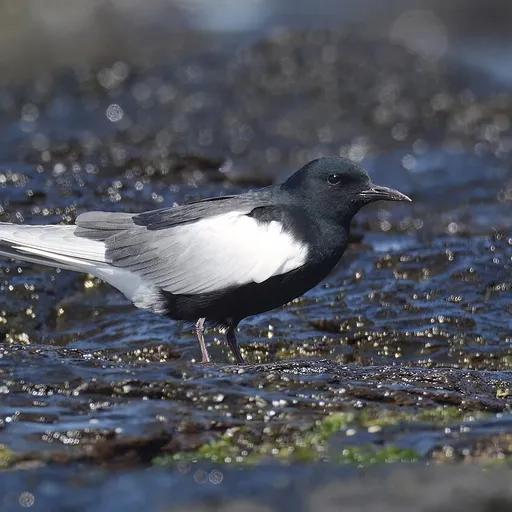
White-winged Tern
Chlidonias leucopterus
Least Concern
Overview
The Chlidonias leucopterus is a small tern species, often referred to as the white-winged black tern, that inhabits freshwater environments across Europe, Africa, Asia, and Australia. It is classified as Least Concern on the IUCN Red List.
Identification
- In summer, the bird features a black head with a pale grey neck and belly, a very dark grey back, and distinct white wings.
- It possesses a short, stubby black bill measuring 22–25 mm and short red legs.
- The face appears tinged yellowish, with a clear white collar isolating the dark mantle.
- In non-breeding plumage, much of the black is replaced by white or pale grey, although some black feathers may remain on the underparts.
Habitat
The species breeds in freshwater marshes ranging from southeast Europe to Central Asia and the Russian Far East, migrating to Africa, southern Asia, and Australia for the winter. It is a rare vagrant in North America and has been recorded in South America.
Diet
Unlike white terns, the white-winged tern does not dive for food but instead flies slowly over the water to surface-pick items and catch insects in flight. Its diet consists mainly of insects and small fish.
Did you know?
The genus name Chlidonias derives from the Ancient Greek word for 'swallow-like', reflecting the bird's agile flight and appearance. Hybridisation between the white-winged tern and the black tern has been documented in Sweden, the Netherlands, and England.
Sources
- Wikipedia · CC BY-SA 4.0
- Wikidata · CC0 1.0