
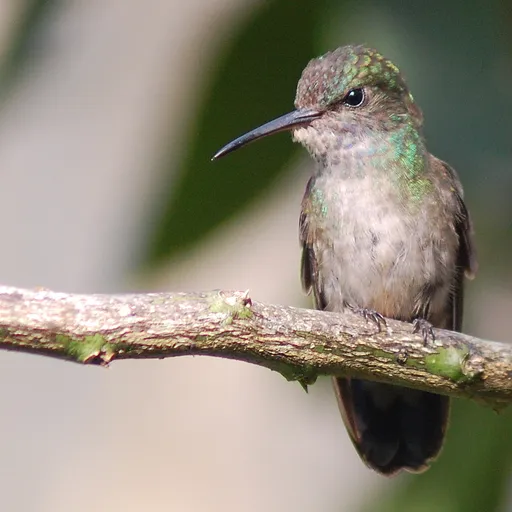
White-chinned Sapphire
Chlorestes cyanus
Overview
The White-chinned Sapphire is a small, non-migratory hummingbird found in northern and eastern South America. It is recognised for its distinctive steel-blue tail and marked sexual dimorphism.
Identification
- Males exhibit a brilliant violet-blue head and throat, a coral-red bill with a dark tip, and a small white chin patch.
- Females possess subdued green plumage with lighter upper parts and grey underparts, lacking the male's bright head and throat.
- Both sexes feature a distinctive steel-blue to blue-black tail, which is a key field mark distinguishing them from the Golden-tailed Sapphire.
- Measuring 8–9 centimetres in length, the bird has golden-green upper parts that transition to copper towards the rump.
Habitat
Inhabiting a variety of environments including lowland tropical forests, woodland edges, and clearings with scattered trees, this species is a permanent resident across much of northern and eastern South America. Its range extends across Argentina, Bolivia, Brazil, Colombia, Peru, and Venezuela.
Diet
Primarily a nectarivore, it feeds on flowers from epiphytes, trees, and shrubs, often at low to mid-levels in forest edges and gardens. It also consumes small arthropods such as beetles, flies, and spiders, which are caught in flight or gleaned from vegetation.
Did you know?
The species was formerly placed in the genus Hylocharis but was moved to Chlorestes in a 2014 molecular phylogenetic study to ensure monophyly.