
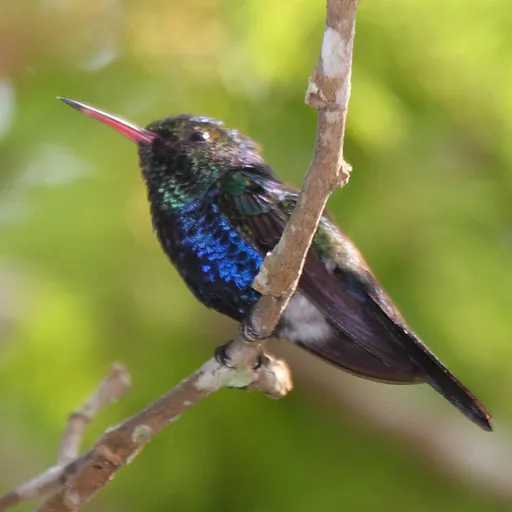
Violet-bellied Hummingbird
Chlorestes julie
Overview
The violet-bellied hummingbird (Chlorestes julie) is a small hummingbird species distinguished by the male's shimmering violet belly. It belongs to the family Trochilidae and is found across parts of Central and South America, with no seasonal migration. The species is currently assessed as being of least concern by the IUCN.
Identification
- Males feature a shimmering violet-blue breast and belly, contrasting with a metallic green back, crown, and throat, while females have a duller metallic bronze-green back and a pale grey belly.
- Both sexes possess long, rounded tails, straight, short bills, and pink lower mandibles, with wings that are dusky with a purple sheen.
- Males average 7.5 cm in length and 3.4 g in weight, whereas females are slightly smaller at 7 cm and 3.0 g.
- To distinguish from similar species like the green-crowned woodnymph, note the rounded tail and green back, as woodnymphs have a notched tail and violet forecrown.
Habitat
This species inhabits the understory of humid deciduous forests, forest edges, and regrowth areas without undertaking seasonal migration. Its range spans central Panama, through Colombia, to southwestern Ecuador and the extreme northwestern point of Peru. Different subspecies occupy specific portions of this range, such as Panama for panamensis, northern Colombia for julie, and western Ecuador and northwestern Peru for feliciana.
Diet
Primarily considered nectarivorous but accurately described as omnivorous, this bird consumes nectar from plants in the Rubiaceae, Ericaceae, Gesneriaceae, and Fabaceae families, alongside small arthropods. Males often defend feeding territories from other males and large insects, and while the species does not form flocks, individuals may congregate at fruit trees and feeders.
Did you know?
Males attract multiple females by singing on perches 1–10 m high or by flying in a 'u' shape in front of them, but they do not mate for life nor participate in rearing the young. Females build nests from plant fibers, animal hair, and feathers between 1.2 and 4.2 m above ground, incubating two white eggs for 15 days before the chicks spend another 20–22 days in the nest.